





“Behind the supermarket, store on the left”: turning entries like that into a point on the map
An address in a database rarely looks like an address. Here is how our geolocation module reads the hardest addresses in Europe, and what comes out of it.

An address in a database rarely looks like an address. Sometimes it is a set of directions: “behind the supermarket, store on the left”. Sometimes it is the name of a Greek island written two different ways, both with a typo. Sometimes it is a postcode and a city, with no street. Sometimes it is a house that locals identify by the owner’s surname rather than a number. That is what everyday customer data looks like in a lot of markets.
For a manufacturer to see its sales on a map without counting the same outlet twice, every one of those entries has to become a specific point. That is the job of GEO4, our geolocation module. Here is how it works, with some of Europe’s hardest markets for addresses as the examples.
Every country breaks addresses in its own way
“Bad address” is not one problem. There are as many kinds of mess as there are countries:
- Ireland — many places have no official address in everyday use. Often the Eircode is the only reliable identifier, and a house may be known locally by the owner’s surname.
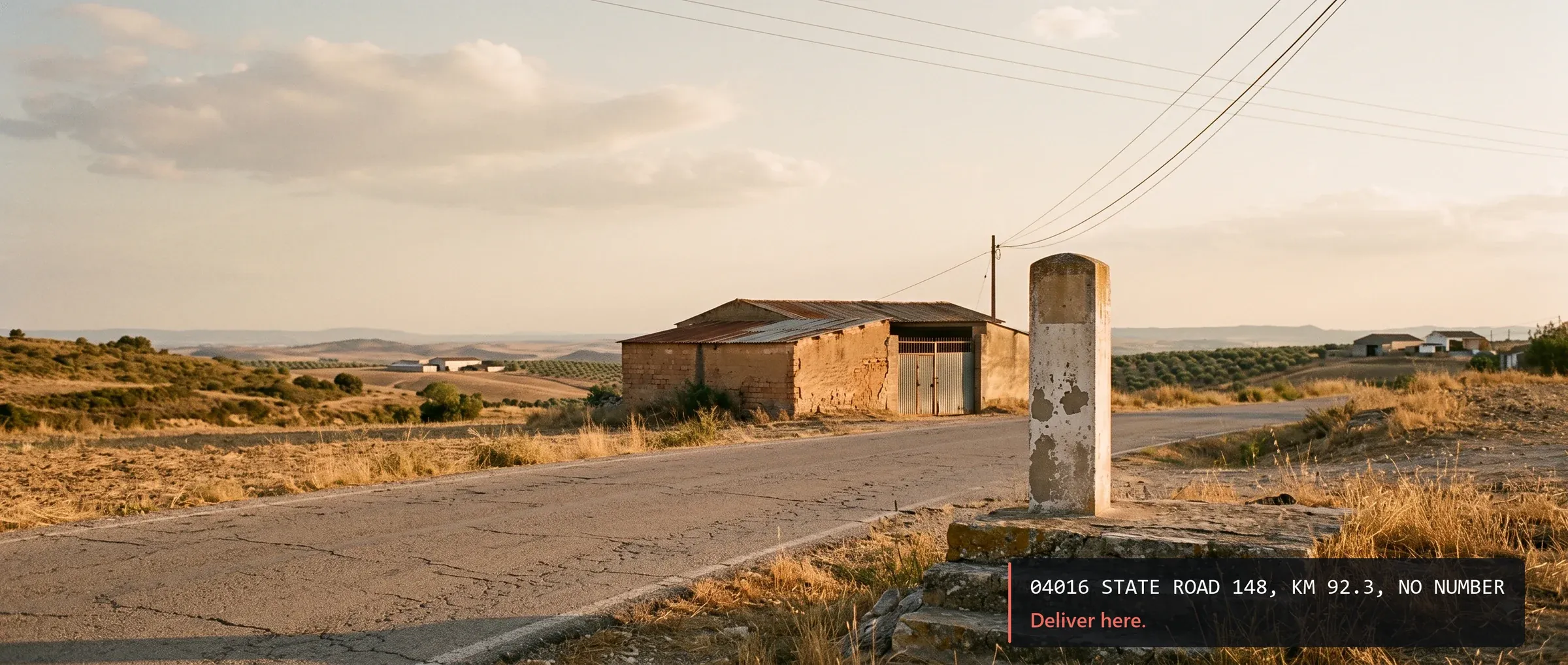
- Italy — “località”, unofficially named areas that do not appear on maps, and addresses given along national roads with a kilometre marker instead of a number.
- Bulgaria — some addresses are stripped to almost nothing (a postcode and a city). Others are overloaded with description: “behind the supermarket, store on the left”.
- Greece — islands and tourist towns with no street names, place names that arrive in a different grammatical form or abbreviated, and single entries that point to several confusing locations nearby.
- France — one place name spelled several ways, CEDEX addresses where the code stands in for the street, missing building numbers.
That is why one universal algorithm is not enough. A Greek address and an Irish one break in completely different ways.
How GEO4 works
We built the engine at the centre of the module ourselves. It recognises the individual parts of an address and labels them: locality, street, building number, postcode. It takes what looks like a random string of characters and puts those parts in the correct order, from country down to building number, even when the address is incomplete, wrong or formatted in an unusual way.
The way an address gets taken apart is universal, but we tune the rules for each market separately, for exactly that reason. That is what the configuration layer is for. We set the rules for a given country and improve them step by step, without rewriting code and without waiting for the next release. Most of the time a new market goes live on configuration alone. If one needs deeper work, new rules or an extension of the engine, we do that too. How much work it takes depends on the complexity of the market and the quality of the customer’s data.
We combine what we know about addressing with external mapping services: we check the address on the map and fill in what is missing, for example the exact position or the region.
The name carries that history. The “4” is a generation number, because GEO4 is the fourth version of our geolocation engine. Each version exists because the last one showed us where we could be more accurate.
Near-complete sales coverage from poor data
For each market we put two things side by side: what percentage of addresses arrived already complete and correct, and what share of sell-out landed on the right outlet. The second number is usually far higher than the first, because the engine can pull enough out of an incomplete or incorrect address to assign the sales correctly.
| Market | Input data quality | Sell-out mapped |
|---|---|---|
| France | 46% | 95% |
| Italy | 52% | 95% |
| Ireland | 61% | 96% |
| Greece | 39.8% | 99% |
| Bulgaria | 44% | 92% |
The hardest of these markets makes the point well. Fewer than 40% of addresses came in complete and correct, the rest broken in one way or another. We still mapped the customers responsible for over 99% of the market’s sell-out.
What the customer gets out of it
Better addresses produce concrete results:
We turn the mess at input into one consistent format, market after market.
The same store stops being counted several times under different entries.
Points of sale show up in reports where they physically are.
A clear picture of which outlets the distributor actually supplied.
Nobody has to match every record to a place by hand.
GEO4 is part of Trade Data Hub. That solution standardises and enriches market data so a manufacturer sees its sales through distributors clearly and without duplicates. With that architecture, the next market is a configuration job.
Every market GEO4 reads today started as somebody’s puzzle. Months of sitting with Greek postcodes, Irish Eircodes and Bulgarian directions, arguing about edge cases and rewriting the rules until the engine reads an address the way a local would. That work has names, and they are worth knowing:
Want your distributor data to arrive already mapped?
Trade Data Hub unifies distributor sell-out across markets, so your reports show real outlets instead of address strings.