






Dynamic Route Optimization for FMCG field sales: AI-driven route optimization software. Service Ratio from 58% to 71%. Plan entire cycles, not just days. Trigger-based priority, what-if simulations, explainable decisions. Runs standalone via API.
Dynamic Route Optimization: every field sales cycle planned, every trigger acted on.
Dynamic Route Optimization is AI-driven route planning built for FMCG field sales teams — not fleet delivery. Plan entire cycles, not just days. Service Ratio from 58% to 71%. Integrates with any CRM or SFA.
Asseco Platform — trusted by global FMCG leaders across 74 markets










Most route optimization tools are built for fleet delivery. FMCG field sales is a different problem.
Generic routing tools optimize distance, time, and cost — as if every stop is a drop-off. But for a field sales rep visiting 20 stores a day, every visit has context: a promotion to prepare, a shelf state to check, a category manager to talk to. The fastest route isn’t the right route.
What you get without DRO
- Daily route plans – every morning, starting from scratch
- Distance optimization – shortest path, regardless of customer priority
- Static schedules – no reaction to business events (promos, OOS, sales drops)
- “Why did this visit get skipped?” – silent gaps, no explanation
- Manual planning – 4-6 hours every Friday in Excel
What you get with DRO
- Entire month planned — every customer served at their agreed frequency, no overlooked stores
- Service Ratio optimization – more time at customer, less in transit
- Trigger-based priority – promos, OOS, Perfect Store drops override routine
- Every skipped visit explained – reason codes, not silent gaps
- Minutes, not hours – full team schedule generated automatically
From customer data to optimized field execution in three steps
A continuous loop: ingest data from any CRM or SFA, plan the optimal cycle, adapt when business changes. Backed by 160+ implementation specialists and 30+ years of FMCG expertise.
Aggregate Customer Data
DRO pulls customer data from your CRM, SFA, or any system via REST API. Addresses, visit frequency, availability, visit duration — all in one shape.
Works with any CRM or SFA via standard API
Plan the Entire Cycle
The AI engine plans an entire month as one problem. Minimizes travel time, maximizes Service Ratio, respects labor law and customer hours.
Business triggers dynamically override routine intervals
Adapt When Business Changes
Plans aren’t static. New promo? Rep on holiday? DRO re-optimizes in minutes — or tells you exactly which customers can’t be reached, and why.
What-if simulations — test scenarios before you commit
See DRO in action — from plan to execution
Two views, one decision chain: the planner designs the cycle in the back-office, the rep receives the optimized route on the device. No handoff gap, no plan that dies in an email.
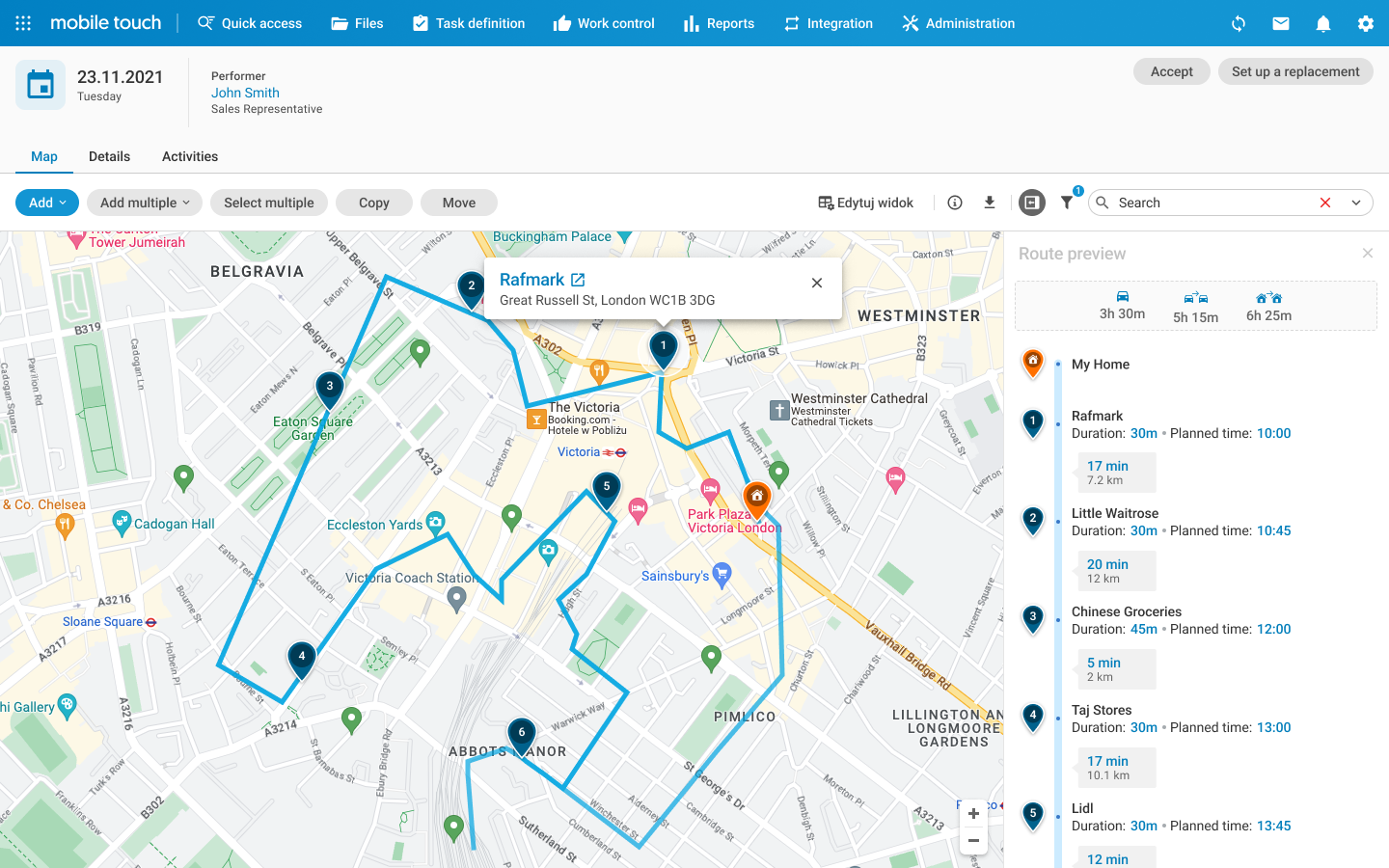
Back-office — plan the cycle
The planner sees the full route on a map and the visit sequence as a timed list. Duration per stop (30 min), aggregated total (3h 32min), and Service Ratio are visible at a glance — so the plan is defensible before it ever reaches a rep.
- Map and visit list, synchronized
- Per-stop duration plus cycle total
- Edit, simulate, re-optimize — without leaving the view
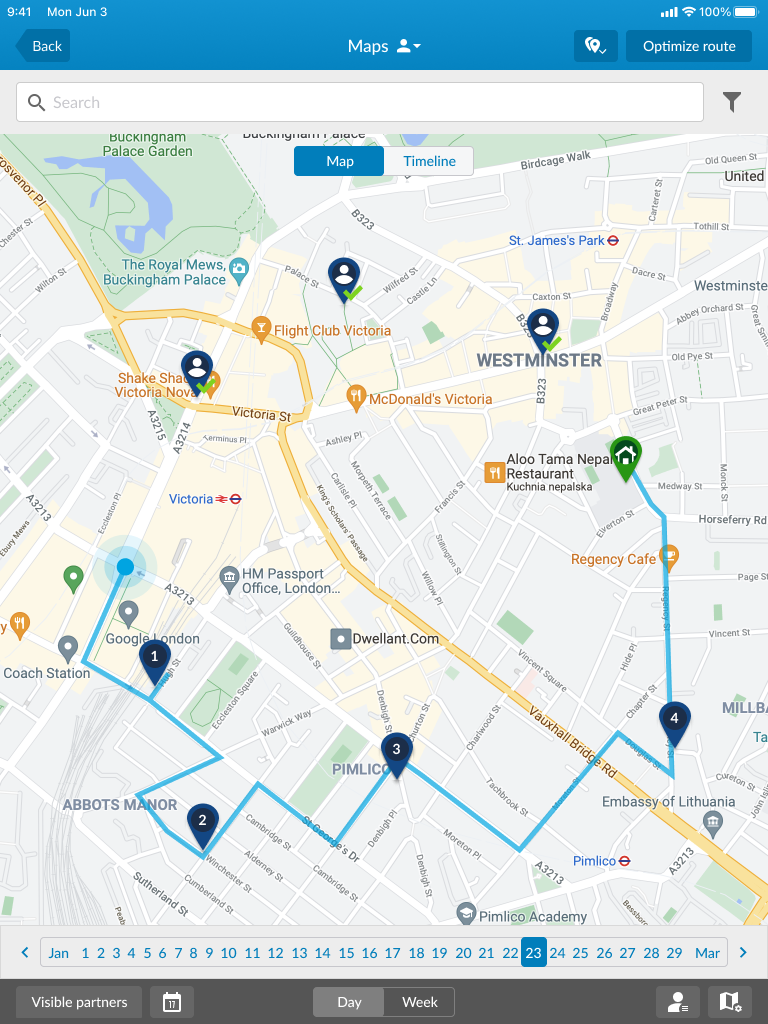
Field — execute the optimized route
The rep opens Mobile Touch and sees the same route the planner built — already optimized, sequenced, ready to start. One tap re-optimizes mid-day if priorities shift.
- Route visualized on map, not buried in a list
- On-device re-optimize when events change
- Works offline — field reality, not WiFi optimism
From planner to rep — one data model, zero re-keying, full auditability.
5 reasons DRO transforms field sales execution
Route optimization tools sell efficiency. DRO sells time — time that reps spend selling instead of driving.
Service Ratio – the % of time a rep spends at the customer vs. in transit – rises from 58% to 71% after DRO adoption (+13 percentage points). For a rep working 8-hour days, that’s 1 extra hour per day of customer-facing time. In a 20-rep team, that’s the equivalent of 2.5 extra reps – without hiring anyone.
By eliminating unnecessary kilometers and clustering visits geographically, DRO adds 1-3 extra visits per rep per day without adding hours. For a team visiting 300 stores a week, that’s 30-60 more store touchpoints – more shelf audits, more orders, more promotional execution.
Field sales managers typically spend 4-6 hours every Friday planning the next week’s routes in Excel. DRO generates the entire team’s monthly plan in minutes. That’s 200+ hours per year per manager redirected from admin to coaching and field time.
When marketing announces a new promotion, DRO automatically rebalances routes to ensure priority stores are visited before launch. No last-minute scrambles. You know exactly which stores will be covered – and which won’t – a week in advance.
Every decision DRO makes has a reason code: why this customer was prioritized, why that visit was skipped. Managers can explain the plan to reps. Reps trust the plan because they understand it. Simulations answer “What if we hire another rep?” in minutes – with hard numbers.
What a typical DRO deployment delivers
Why no named customer here?
DRO client references are under NDA. Ask for a tailored reference call during demo — we can match your industry and scale.
“Before DRO, our reps spent 3 hours a day in transit between stores. Now it’s 2 hours. That extra hour per rep per day — 20 hours per rep per month — is time for more customer conversations, more shelf audits, more selling.”
“We didn’t hire a single new rep; we just gave every existing rep more time to do what they’re paid to do. The what-if simulations changed how we plan ahead of promotional launches.”
58% → 71%
Service Ratio improvement
15% less
Fuel & travel cost
+1 hour/day
Extra customer time per rep
6 optimization layers. One AI engine. Your plan.
DRO is built around what reps actually do in the field — every layer addresses a real-world constraint.
Cycle-wide planning
DRO plans the entire month as one integrated problem — not day-by-day. Customer visit intervals are equal across weeks. Distance and time minimized globally, not per day.
Core · +10–20% visits per day
Service Ratio optimization
Maximize time spent at the customer, not in transit. DRO actively optimizes this KPI — typical improvement 58% → 71% (+13 pp).
Core · +1 hour/day customer-facing
Trigger-based priority
Promotions, out-of-stock risks, Perfect Store score drops, share-of-shelf decline — each trigger bumps a customer up the priority queue. Configurable per customer, category, market.
Core · Priority stores always served
What-if simulations
“Can Tom’s territory absorb 15 new stores?” “What if two reps go on vacation?” Named, persistent simulations compared side-by-side with hard KPIs.
Advanced · Decisions based on data
Explainable decisions
No silent gaps. If a visit can’t fit, DRO tells you exactly why: “Labor law limit exceeded”, “No availability window”, “Distance beyond reach”. Reps and managers trust the plan.
Advanced · 95%+ plan adoption rate
Standalone API
DRO doesn’t require Mobile Touch or the full Asseco Platform. It integrates with any CRM, SFA, or ERP via standard REST API. Start with DRO, expand later.
Core · Deploy in weeks, not months
Which analysts and standards recognize Asseco Platform?
Independent recognition to support your internal business case.



Gartner does not endorse any vendor, product or service depicted in its research publications, and does not advise technology users to select only those vendors with the highest ratings or other designation. Gartner research publications consist of the opinions of Gartner’s research organization and should not be construed as statements of fact. Gartner disclaims all warranties, expressed or implied, with respect to this research, including any warranties of merchantability or fitness for a particular purpose. Gartner, Market Guide for Retail Execution Management in Fast-Moving Consumer Goods, April 2025, G00768127. GARTNER is a registered trademark and service mark of Gartner, Inc. and/or its affiliates in the U.S. and internationally, and is used herein with permission. All rights reserved.
How does DRO compare to other route optimization tools?
The routing software market is crowded. Most tools are built for fleet delivery. A few target field sales — but stop at routes + CRM sync. Where routing tools stop, DRO goes further — combining entire cycle planning, Service Ratio optimization, and business trigger-based scheduling.
| Capability | Asseco DRO | Route4Me | Badger Maps | PepUpSales | Repsly | BeatRoute |
|---|---|---|---|---|---|---|
| FMCG field sales focus | Yes | Multi-industry*1 | General sales*2 | Yes | Yes (CPG) | Yes |
| Plan entire cycle (month) | Yes | Daily | Daily | Daily | Daily*3 | Manual*4 |
| Service Ratio optimization | Yes | — | — | — | — | — |
| What-if simulations | Yes | Partial*5 | No (Align)*6 | No | No | No |
| Trigger-based priority | Yes | No | No | No*7 | No | No |
| Explainable decisions (reason codes) | Yes | No | No | No | No | No |
| Standalone API integration | Yes | Yes | Yes | Partial*8 | Yes | Yes |
| Part of full platform (SFA+IR+TDH) | Yes (5 products) | Routing only | Standalone app | SFA+DMS+Mobile*9 | CPG RetX*10 | SFA + DMS |
Data sourced from vendor websites and public documentation, April 2026. Verified via Ahrefs SEO data and public product pages. For latest vendor claims, see respective websites.
*1 Route4Me: General-purpose route optimizer for fleet delivery, field sales, and logistics — not an FMCG specialist. No SFA, beat plan, or promo execution module.
*2 Badger Maps: Primarily B2B outside sales across multiple industries (medical devices, manufacturing, telco, food). FMCG field sales supported but not primary positioning.
*3 Repsly: Calendar-based scheduling for individual store visits. Visit frequency manually configured; no algorithmic cycle planning or Service Ratio calculations.
*4 BeatRoute: Core “beat plan” covers monthly territory visit schedules (outlets, frequency, rep assignment) — cycle-level planning, but manual/static. No AI optimization, no Service Ratio, no what-if simulations.
*5 Route4Me: Offers scenario dispatching (multiple route alternatives) and territory rebalancing tools. Not equivalent to full what-if simulations (headcount changes, frequency adjustments, promo impact modelling).
*6 Badger Align (enterprise tier) includes territory planning features. No route-level what-if simulations documented.
*7 PepUpSales: Priority flags and urgency routing supported at SFA level. No system-level trigger integration (OOS signals, Perfect Store scores, promo activations).
*8 PepUpSales: REST API for SFA/DMS data sync. Route optimization API not documented as standalone.
*9 PepUpSales: Platform includes SFA, Distributor Management System (DMS), Van Sales, mobile ordering. No AI Image Recognition or data-integration modules.
*10 Repsly: Retail Execution (RetX) + Retail Intelligence Hub. Core: store audits, compliance, AI image recognition. No van sales or full SFA order management.
What-if simulations — know the impact before you change the plan.
Route optimization tools show you today’s optimal route. DRO lets you ask: What would happen if…? Named, persistent simulations answer territory, capacity, and priority questions in minutes.
“Can Tom absorb 15 new stores from the retailer contract?”
Before you sign the contract, simulate it. DRO shows: coverage drops to 82%, 5 visits skipped. Try 10 stores to Tom + 5 to neighbor rep? Coverage 97%, 1 skip. Decision in 10 minutes — not in a month of trial and error.
“What if two reps go on vacation in the same week?”
Simulate the impact before you approve holidays. DRO redistributes load across remaining team — or tells you which customers will be skipped and why. You know the cost before you agree.
“What if we cut shifts from 8 to 6 hours?”
Labor contract changes, budget cuts — simulate the impact on coverage. Which customers fall out? Which territories become unviable? Data-driven input to negotiations, not gut feeling.
“What if we add cold chain compliance as a priority?”
Configurable triggers let you model new business priorities. Compare side-by-side: before vs after cold chain compliance scoring. See the trade-offs in KPIs before you commit.
Start with DRO. Scale with the full platform.
DRO is one module within Asseco Platform — a complete end-to-end FMCG execution suite. Start with DRO. Scale as your business scales.
One integrated suite. Your complete retail execution stack.
Common questions about Dynamic Route Optimization
Dynamic route optimization (DRO) is AI-driven software that plans entire field sales cycles — not just daily routes. It aggregates customer data (addresses, visit frequency, availability), respects business constraints (labor law, priority triggers), and generates optimized schedules in minutes. Unlike generic route planners that optimize distance, DRO optimizes Service Ratio — the percentage of time reps spend at customers vs. in transit.
Logistics tools (Route4Me, MaxOptra, OptimoRoute, Routific) are built for fleet delivery — where every stop is a drop-off lasting 2 minutes. FMCG field sales is different: reps spend 20-40 minutes at each store, every visit has context (promotions, shelf state, category priorities), monthly intervals matter, and business triggers should override routine schedules. DRO is built for this reality.
Those tools focus on routes + territory + basic CRM sync — good for daily planning. DRO adds an enterprise AI layer: entire cycle planning (not day-by-day), Service Ratio optimization, trigger-based priority, what-if simulations, and explainable decisions. DRO is also part of a 5-product FMCG platform — you can scale to full field execution without replatforming.
DRO runs standalone. It integrates with any CRM, SFA, or ERP via a standard REST API — you don’t need to replace your existing stack. If you use Salesforce, Veeva, SAP, or any other system — DRO connects via API. Deploy in weeks, not months.
Service Ratio is the percentage of a field rep’s working time spent at customers (selling, auditing, merchandising) versus in transit (driving between stores). For most FMCG field teams, Service Ratio is 55-60%. DRO typically improves Service Ratio to 68-72% — adding 1+ hour of customer-facing time per rep per day.
Standalone deployment: 4-8 weeks from data integration to first optimized cycle. Full Asseco Platform deployment: longer, depending on scope (SFA, IR, TDH). 160+ implementation specialists with 30+ years of FMCG expertise support every deployment.
Pricing depends on team size and deployment scope (standalone vs. part of full platform). Contact us for a demo and quote based on your specific scenario.
Asseco Platform is trusted by global FMCG leaders across beverages, spirits, confectionery, food & grocery, and personal care — with 125,000+ platform users across 74 markets. Named client references available on request. Case studies available under NDA.
See DRO in action — tailored for your FMCG scenario
Book a 30-minute demo with our field execution specialists. We’ll configure a live simulation based on your industry (beverages, confectionery, food & grocery, personal care), team size, and current routing challenges. No slides — real DRO with your data shape.
Trusted by global FMCG leaders across 74 markets · ISO/IEC 27001:2022 certified · 30+ years of FMCG expertise