





Share of Shelf in Practice: 8 displays, 3 corporations, 10 brands stuck on the shelf
I walked into a Kaufland in early May 2026, at the start of peak grilling season. The goal was simple: see how the ketchup category really looks on the shelf. I left with thirteen photos and one non-obvious observation.
What I found behind 15 brands of ketchup
Share of shelf is the share of visible space a brand holds in a category. It decides what shoppers see first. Here, 15 ketchup brands split the main shelf, but three corporations stood behind all eight off-shelf displays.
On the main shelf, I counted 15 brands of ketchup. Heinz, Pudliszki, Develey, Hellmann’s, Roleski, Kotlin, Winiary, Włocławek, Tortex, Dawtona, Błonie, Łowicz, Benita, Kupiec, K-Classic. Plus sachets and an ethnic SKU. A classic full hypermarket compact category.
The real category sat off the main shelf.
I counted 8 additional off-shelf displays: pallets, branded shippers and gondola ends. Seven of them are manufacturer displays, and those belong to 3 corporations: Kraft Heinz, Maspex, and Nestlé. The eighth, the gondola end, is Kaufland’s own category display, and Pudliszki dominates it.
Kraft Heinz Poland paid for four of them and dominates the fifth, the one Kaufland built. Together they work as a five-stage funnel, and each stage plays a different role: brand awareness at the entrance, decision gate before the aisle, cross-merchandising in the category aisle, conversion peak at the meat counter, last-touch fulfillment at the packaged cold cuts. Maspex runs two displays around the frozen section. Nestlé occupies one, facing the bread aisle, on a pallet sitting right next to the Kraft Heinz one.
Three corporations divide the entire off-shelf battleground between themselves, with Kraft Heinz dominating through a five-stage purchase funnel. The remaining 10 brands sit across 6 entities: Develey, Unilever (Hellmann’s), Roleski, Schwarz Gruppe (Kaufland’s own K-Classic), a group of smaller independent Polish producers, and Maspex, which buys displays but not for Włocławek. None of those 10 brands has a display of its own.
Which store, and why the sample matters
The store is a Kaufland. I call it a hypermarket compact: the format that sits between a supermarket and a full hypermarket. That is my label for it, not a panel category. Kaufland practically owns this format in Poland: 2,500-4,000 m² of floor, 15,000-25,000 SKUs, the full FMCG range plus some non-food (chemistry, small appliances, textiles, seasonal garden).
This matters because it’s the format where the real off-shelf battle in Polish FMCG plays out. Discount (Biedronka, Lidl) and classic hypermarket (Auchan, Carrefour) play this category very differently, and I’ll come back to both in upcoming FMCG Anatomy episodes. Kaufland compact keeps the whole game in one pass.
Why ketchup, and why now
The timing first. Early May is the start of peak grilling season in Poland. For the ketchup category, this is the strongest period of the year: sales rise 40-60% compared to the winter baseline. Producers invest the biggest exposure budgets, marketing campaigns, branded shippers, and gazette promotions during this window. If you want to see a category at maximum battle intensity, this is when you go in.
Then the category itself. Ketchup is a good first category to look at this way, because three things matter in it at the same time: 90% household penetration (almost everyone in Poland buys it), global corporations sitting on the same shelf as local Polish family producers, and a category mature enough that the off-shelf game is real, not theatrical. Plus the red colour. Ketchup screams at you from the aisle entrance.
Main shelf: 15 brands, 7 corporations, and one group of smaller producers
The category shelf in the sauces aisle spans three regal sections. Three photos below capture the left, middle, and right sections, and together they tell the first part of the story.
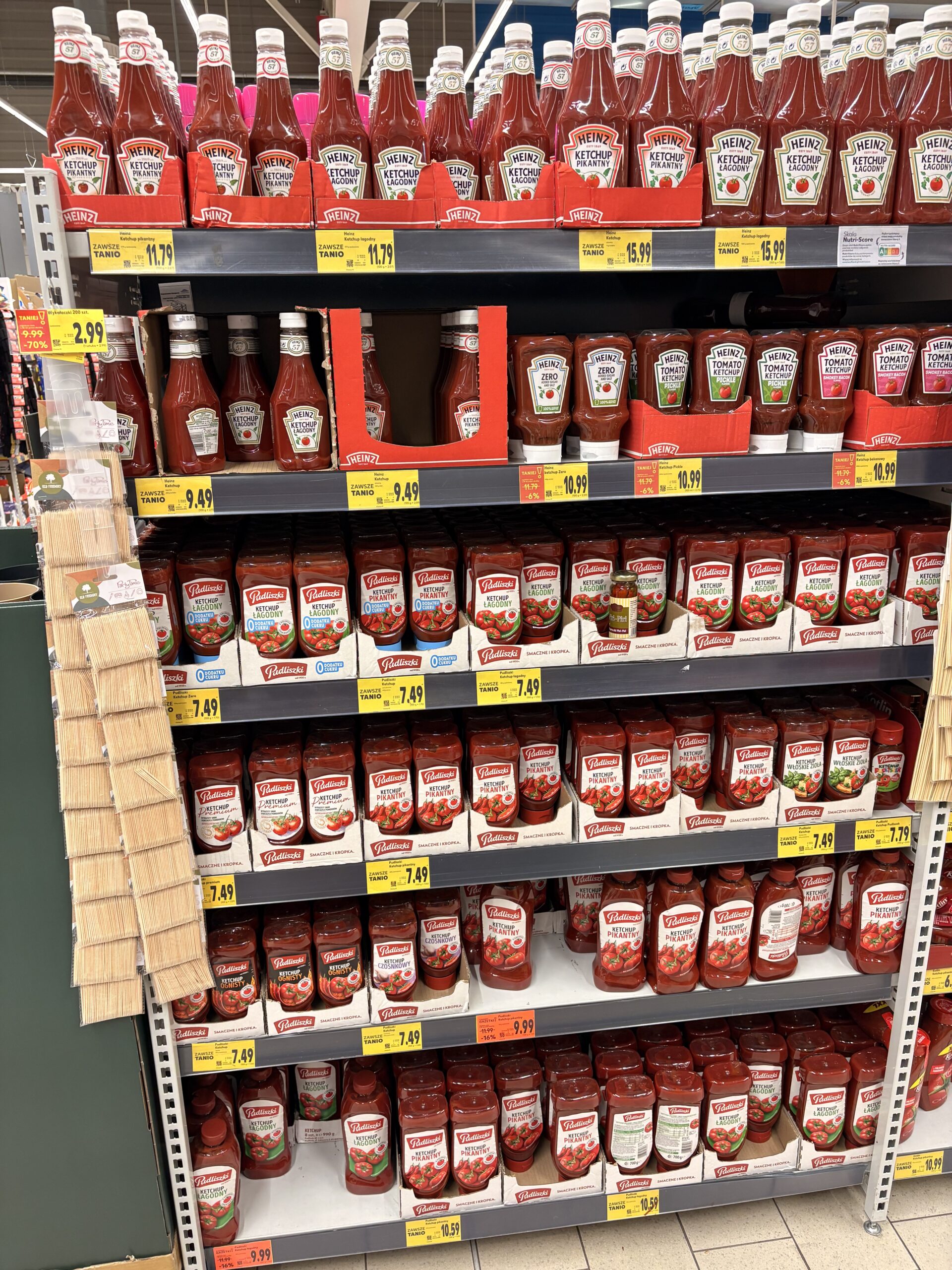
Main shelf, left section. Pudliszki dominates 4 vertical shelves with Heinz on top. The full Kraft Heinz portfolio side-by-side.
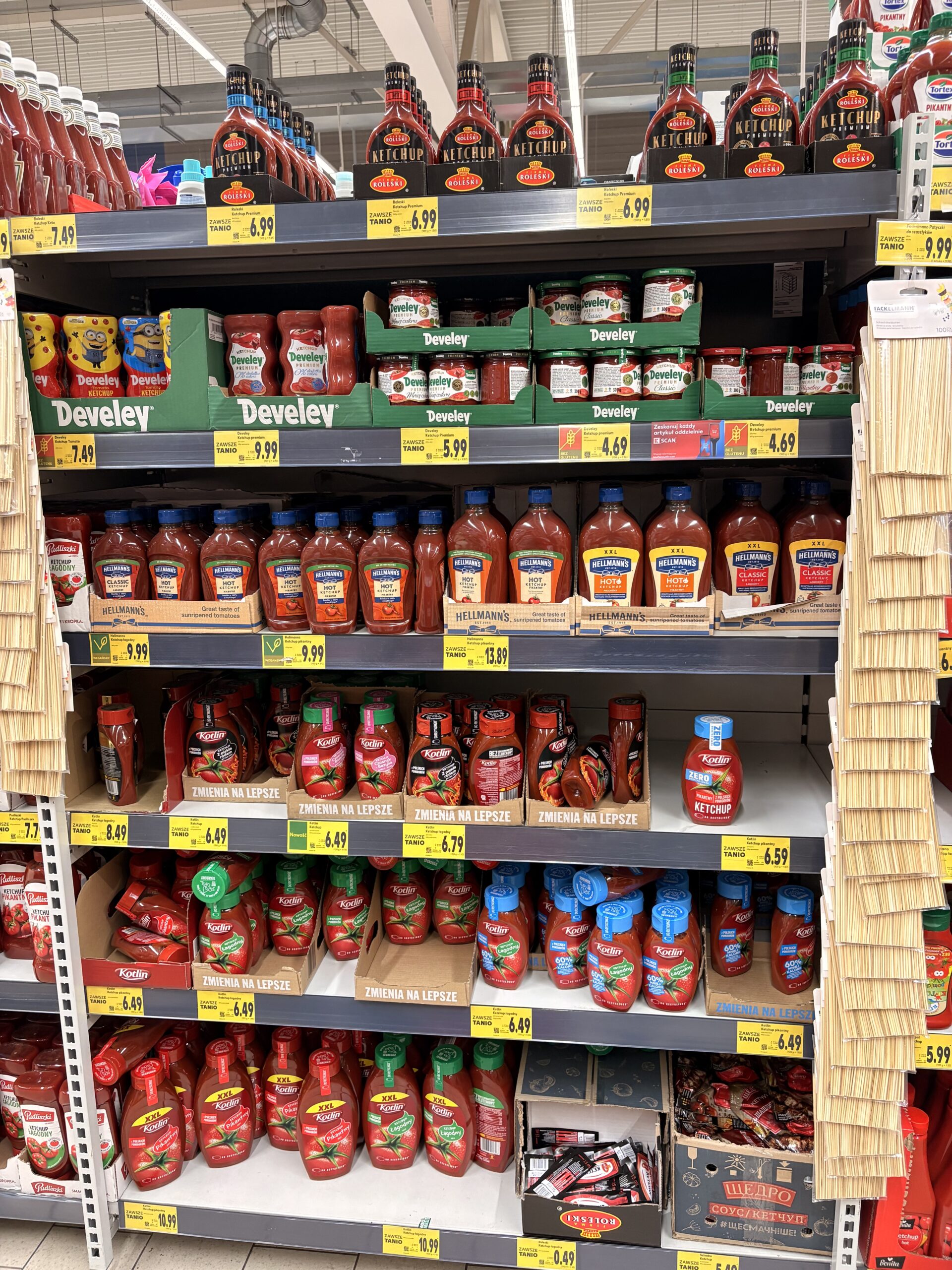
Main shelf, middle section. The mainstream and premium contest zone: Roleski, Develey, Hellmann’s, Kotlin. Develey and Hellmann’s with dedicated branded shelf trays.
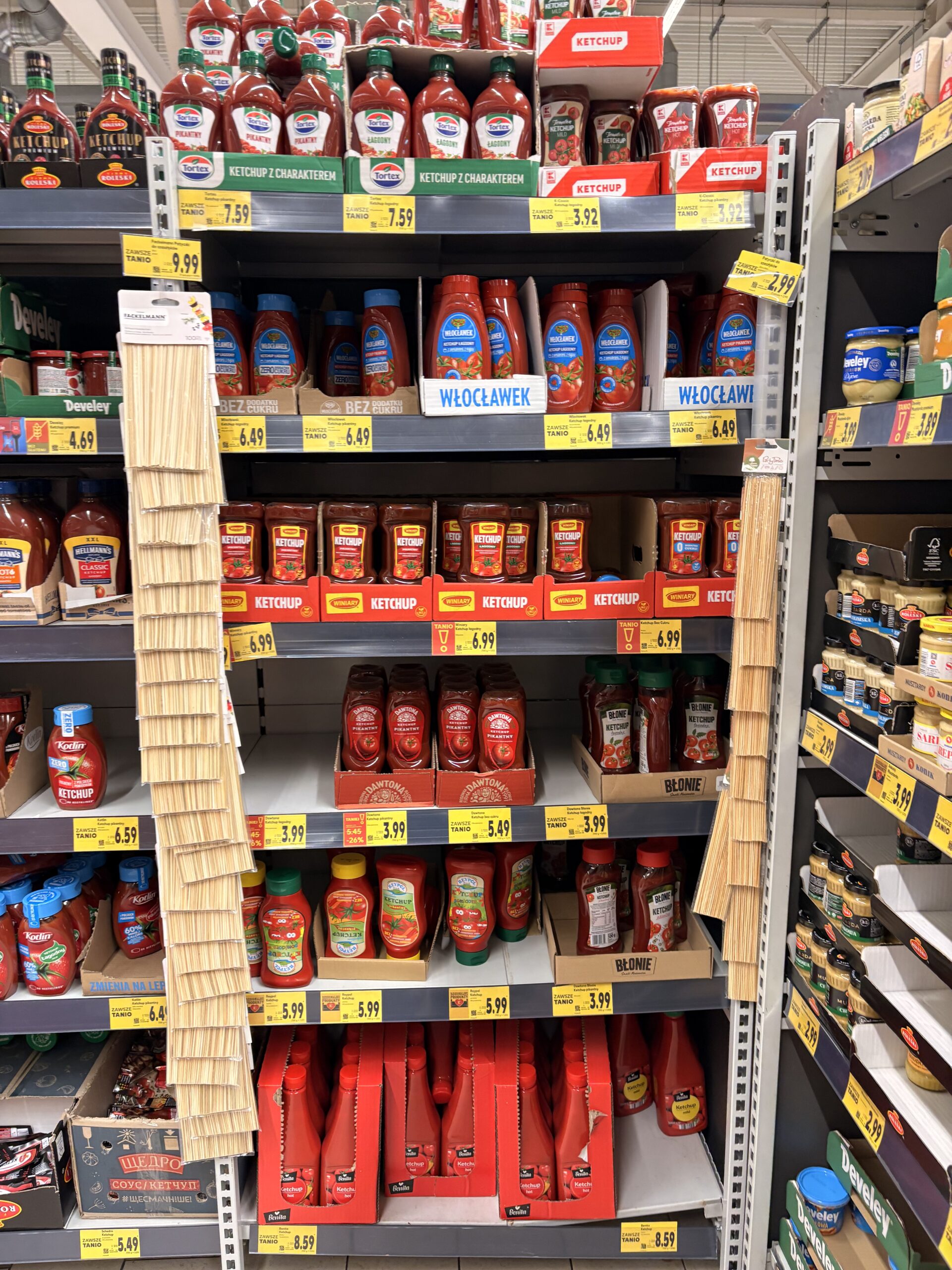
Main shelf, right section. The lower-tier and private-label part of the category: Tortex, Winiary, Włocławek, K-Classic and smaller brands. K-Classic (Kaufland’s own brand) is tucked up high with only 2-4 facings.
15 brands sounds impressive. Behind them stand 8 entities.
Behind those 15 brands stand 7 corporations plus a group of smaller independent Polish producers:
Plus Roleski sachets and Ukrainian Schedro pacs sit on the floor below the shelf. These are small SKUs serving impulse and ethnic-shopper niches.
A few things jump out. Kraft Heinz and Maspex together control more than half of the shelf facings. And the Kraft Heinz case is genuinely interesting: Pudliszki feels like a local Polish brand to most shoppers (by heritage it is). Heinz feels global and premium. Both belong to the same American company, which acquired Pudliszki in 1997. Same parent, two completely different brand identities, by design.
The brand layer is a façade. The real market structure is the corporate layer behind it, and only three of those companies pay for off-shelf visibility.
Three clear price tiers: what they tell us
The category prices range from 3.92 PLN to 15.99 PLN, about a 4× spread between cheapest and most expensive. That’s a healthy range. Every shopper budget finds an option.
Heinz “57” sits at the top. It is the bottle most shoppers recognize as “premium” before they even read the label.
Golden zone: who won share of shelf
Pudliszki dominates the shelf: 4 vertical shelves in the left section, side-by-side with Heinz on top. About 25-30% of all facings in the category. The block is so big that any shopper entering the aisle sees the Kraft Heinz portfolio first, whatever height they’re looking at.
Heinz plays its shelf smartly. The heritage “57” bottles (classic upright glass with the iconic “57” mark) sit on the top shelf of the left section, above the shopper’s natural line of sight. The everyday squeeze bottles (upside-down with a flip-cap) sit at eye level, the most visible spot in any aisle, where the bulk of purchases happen. One brand, two formats, two shopper types served from one shelf section.
The middle section is the mainstream + premium contest zone: Roleski, Develey, Hellmann’s and Kotlin share the eye-level here.
The right section holds Tortex, Winiary, Włocławek, K-Classic and smaller brands, the lower-tier and private-label part of the category.
Confirmed: Kaufland doesn’t push its own brand here
K-Classic, Kaufland’s private label, has in this category only 2-4 facings positioned at the TOP of the right section, priced at 3.92 PLN.
Standard category management for a discounter or hypermarket compact: PL sits next to the leader, at eye-level, as a “parasiting” mechanic, the “same thing, cheaper” effect. Lidl runs this play in Germany with its Kania private label. Kaufland, in ketchup, doesn’t push its own brand.
It’s a deliberate choice. Kaufland has been operating in Poland for 25+ years and runs on its own category data: per SKU, per store, per week. The decision not to push K-Classic in ketchup is almost certainly grounded in that data: in this category, Polish shoppers want a brand they know, not a cheaper unknown.
EDLP, not Hi-Lo: what “always cheap” really signals
The yellow "Zawsze tanio" [Polish: "Always cheap"] labels are on ~90% of SKUs. These are not gazette prices. This is EDLP (Every Day Low Price), the price anchored below recommended retail and held there. For the premium tier (Heinz, Develey, Hellmann’s) this is quietly good news: on a Hi-Lo shelf, a competitor’s temporary -30% pulls shoppers across price tiers. EDLP does not let that happen, so premium buyers stay premium buyers more often. Whether "Zawsze tanio" really is EDLP or just a marketing slogan is a fair question, and one I can only answer by comparing the same SKUs across Biedronka, Lidl, Auchan and Carrefour. That comparison is coming.
What I described so far is just the shelf category. The real battle plays out off the shelf.
The next 7 sections walk through the 8 displays in the order a typical shopper encounters them, from the entrance to the checkout. Each display, in my reading, plays a different role.
Display #1: Heinz at the entrance (brand awareness)
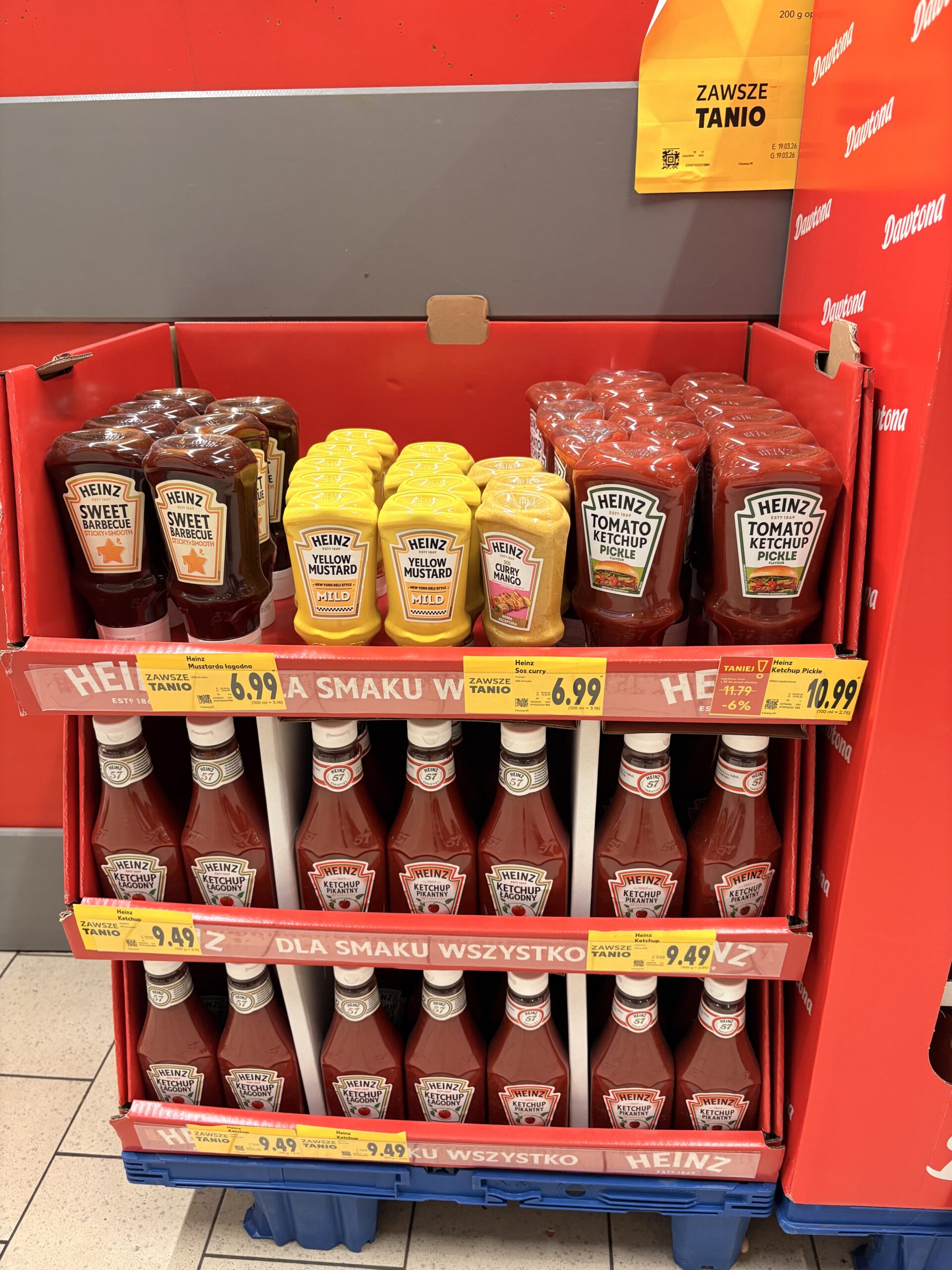
On the left side of the entrance, just past the anti-theft gates, stands a low branded Heinz shipper (~1.2 m high) with the headline “DLA SMAKU WSZYSTKO” [Polish: “Everything for taste”]. On the shelves: Heinz Sweet Barbecue, Yellow Mustard 6.99 PLN, Curry Mango sauce 6.99 PLN, Heinz Ketchup Pickle 10.99 PLN (6% off the 11.79 PLN regular), Heinz Ketchup “57” (mild and spicy) 9.49 PLN.
The shipper holds mustards, BBQ and exotic sauces. Heinz reminds shoppers it makes more than the famous bottle. The job is recognition, not basket-fill.
Execution is weak. The entrance is what Paco Underhill calls the decompression zone: the first few metres inside the door. The shopper is adapting their eyes and planning, not yet ready to buy. Height below eye-level. On the opposite side of the entrance stands the fruit and vegetable section (classic Kaufland fresh-first entrance), colorful and naturally attractive to vision. The low monochromatic red Heinz shipper loses this visual competition.
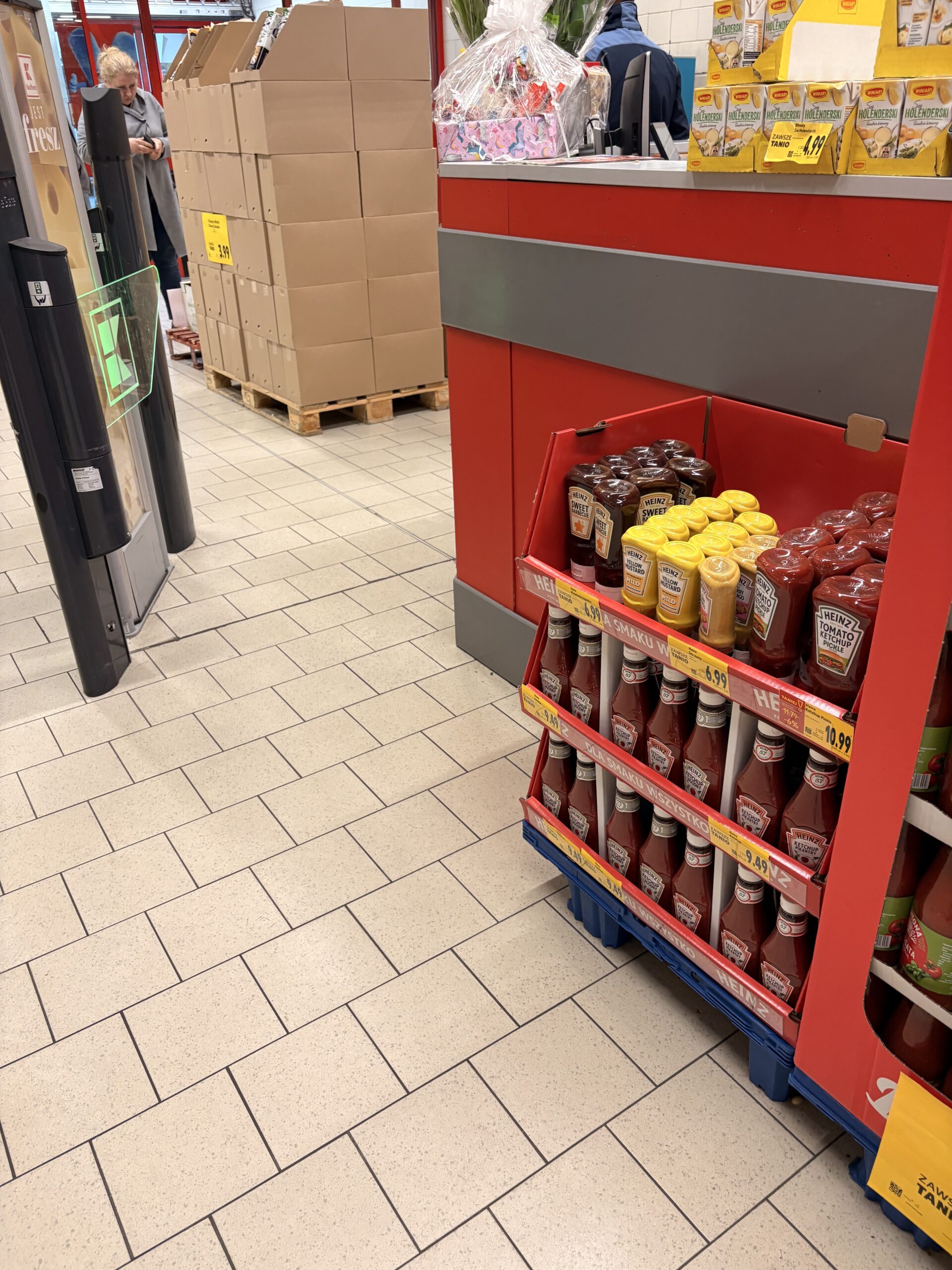
Display #1. Heinz branded shipper at the entrance, ~1.2 m high, portfolio showcase.
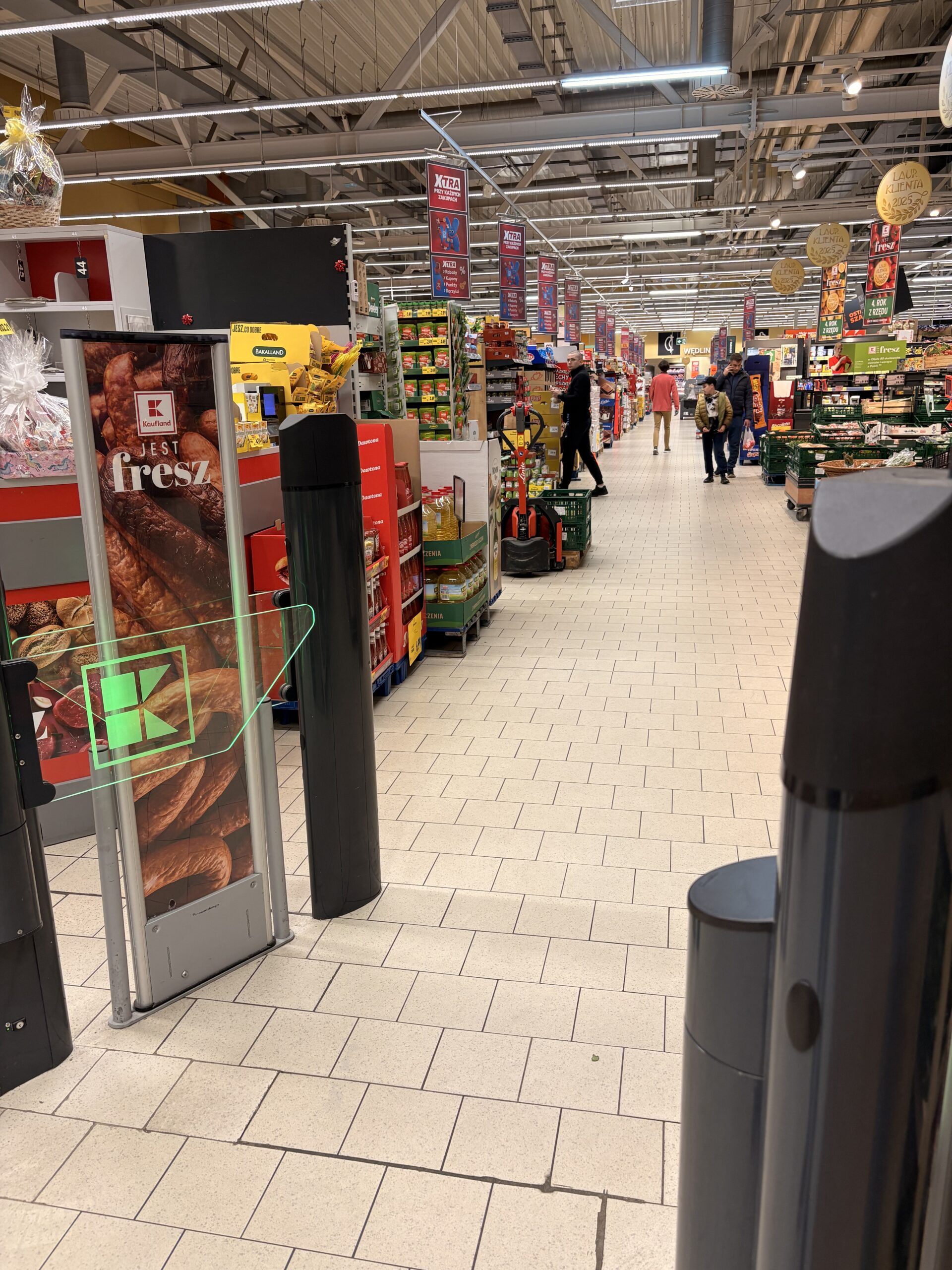
Wide context: the Heinz shipper sits in the transition zone, competing for attention with the fresh produce section on the opposite side.
Function in the Kraft Heinz funnel: brand awareness reminder. The weakest link in five KH displays, but still presence.
— My readingDisplay #2: Gondola end (decision gate)
The shopper leaves fresh produce, walks the main aisle, has on the left a gondola end ~2 m high. Eye-level dominates Pudliszki: the 990 g bottle at 9.99 PLN on gazette promotion, 16% off the regular 11.99 PLN, stacked in 8-count shelf-ready cartons, plus the standard squeeze at 7.49 PLN. Touch-level holds the entire pallet of Pudliszki XXL packs in boxes. Plus on eye-level: Hellmann’s Classic 9.99 PLN, Veg-i-veggie vegan sauces, Prymat mustards, Sauce Dzik on gazette.
Execution is strong. Gondola end is widely considered prime retail real estate. The common rule of thumb in the trade is 2-4× the sell-through of a mid-aisle location.
But the more interesting part is the psychological function: the shopper is about to decide whether to turn right (the ketchup category aisle) or continue. Pudliszki on this end-cap looks designed to close the decision before the turn: the shopper takes Pudliszki, doesn’t enter the category aisle, doesn’t see Heinz, Kotlin, or Develey.
The network placed Hellmann’s at 9.99 PLN, the same shelf price as the promoted Pudliszki bottle beside it. Same price, half the volume: 9.99 PLN buys 990 g of Pudliszki or roughly 490 g of Hellmann’s. That is what makes Pudliszki read as the value pick. My reading is that this is Kaufland’s choice and not Unilever’s, likely to keep the gondola end from being mono-branded.
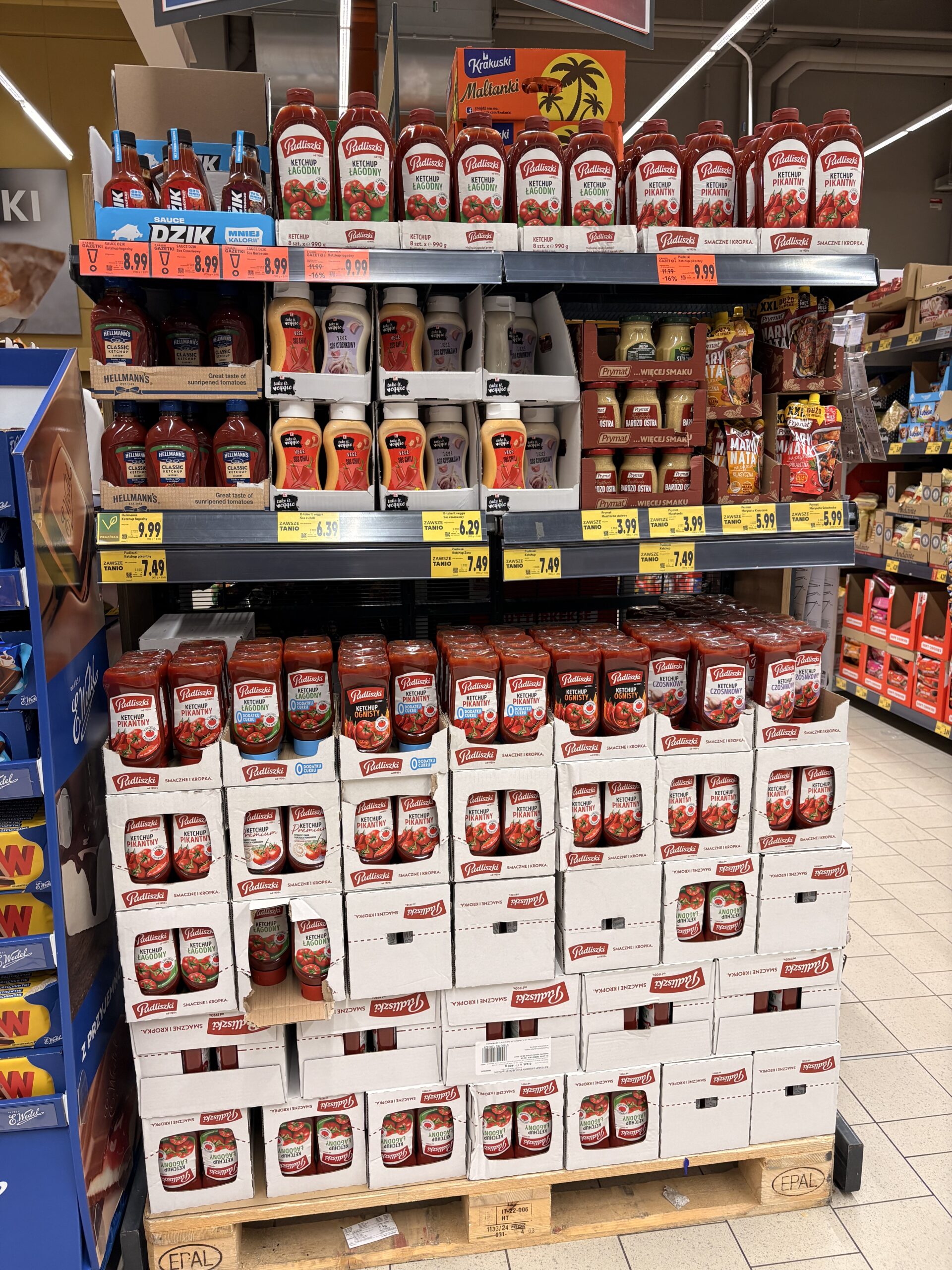
Display #2. Gondola end with Pudliszki dominance and Hellmann’s as a price anchor.
Function in the Kraft Heinz funnel: decision gate. The category gate-keeper.
— My readingDisplay #3: Pudliszki + Heinz in the category aisle (cross-merched with chips, even here)
If the shopper does turn into the category aisle, mid-aisle they encounter a branded Pudliszki “Smaczne i Kropka” display: a red shipper roughly 1.3 m high (a quarter-pallet base with four rows of bottles), holding Pudliszki XXL Mild and Spicy (700 g, 10.59 PLN “ALWAYS CHEAP”). To the left of the display sit chips: Lay’s Green Onion and Crunchips Paprika, classic snack and condiment cross-merchandising.
First surprise: on the top shelf of the Pudliszki-branded display stands a Heinz “57” bottle. Looks like an employee mistake. But it’s not. Display #6 (below) proves this definitively.
This is the first of two pieces of evidence in this store that Kraft Heinz Poland systematically combines Heinz and Pudliszki on shared shippers. One company manages both brands from one team, with shared shippers and good-better-best pricing in a single location.
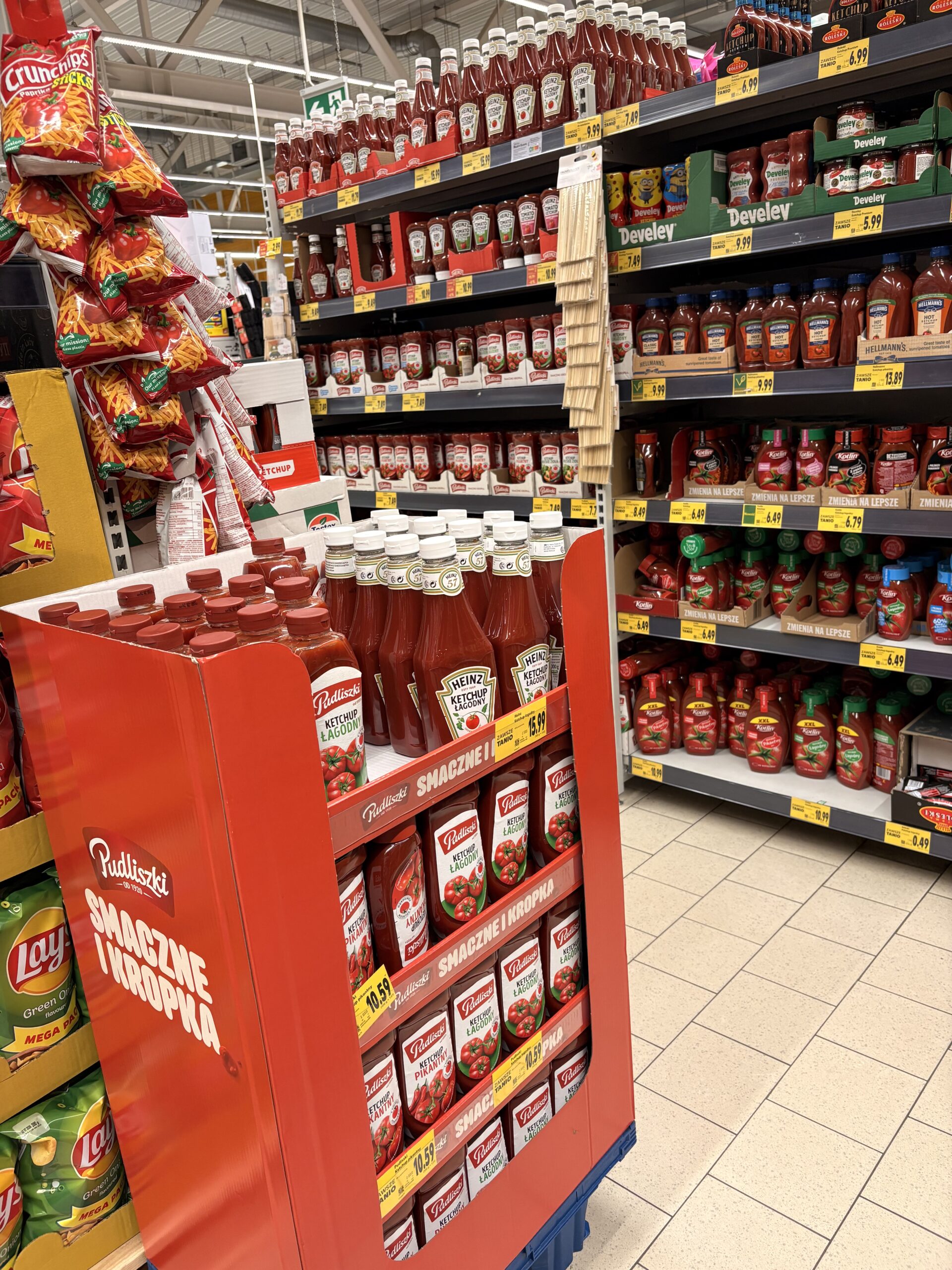
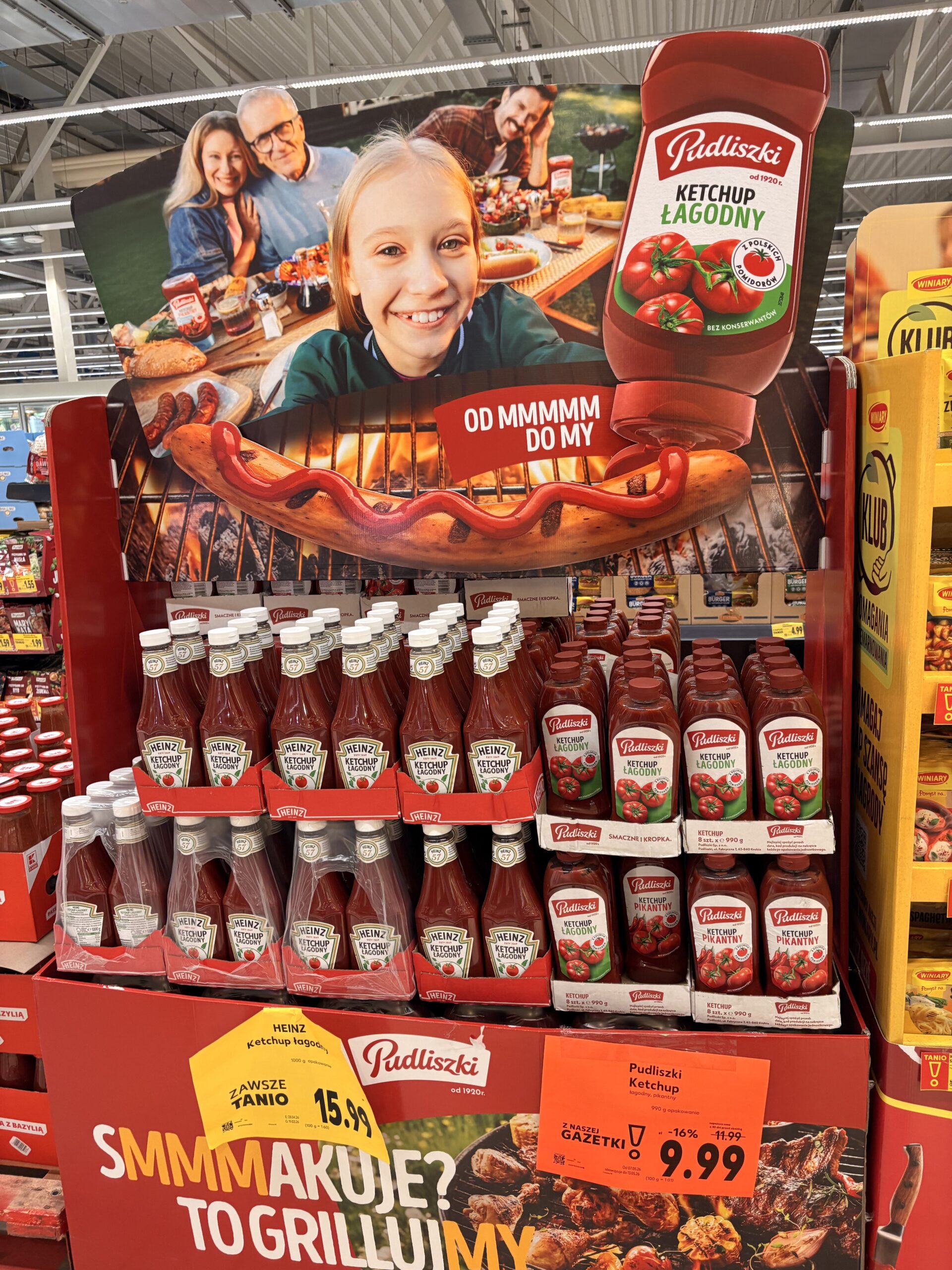
Display #3. Branded Pudliszki shipper with chips alongside. Smoking gun #1: a Heinz “57” bottle on the top shelf of a Pudliszki-branded display.
Function in the Kraft Heinz funnel: XXL trade-up + cross-merchandising with snacks.
— My readingDisplays #4 and #5: Maspex pallets before the frozen section
From the category aisle we return to the main aisle. On the right, before the frozen section, stand two Maspex pallets side by side.
The first is a Kotlin “Porcja na Raz” [Polish: “One-time portion”] pallet: a full convenience sachet line: ketchup, mustard, sauces (Sriracha, BBQ, Sweet Chilli Mango), liquid marinades, all at 2.99 PLN, single-portion ~75-100 g.
This is Maspex’s play for the convenience shopper. While Pudliszki goes XXL and Heinz goes premium, Maspex carves out the single-portion niche: younger shopper, hot dog, sandwich, single meal, social occasion. Per 100 g that 2.99 PLN is more than twice the price of the XXL squeeze bottle, but the shopper pays for convenience and portion.
Right next to it stands a second Maspex pallet. The shipper itself is printed with BOTH brands: Kotlin and Łowicz, tagline “PYSZNY CAŁY DZIEŃ!” [Polish: “Delicious all day!”]. On the day I was there, the pallet was filled with Kotlin only (mild and spicy, red and blue caps, 6.49 PLN “ALWAYS CHEAP”). My read: Maspex likely uses one reusable carton design across multiple campaigns: sometimes Kotlin only, sometimes Łowicz only, sometimes a mix. Either way, the shipper’s printed branding is the point.
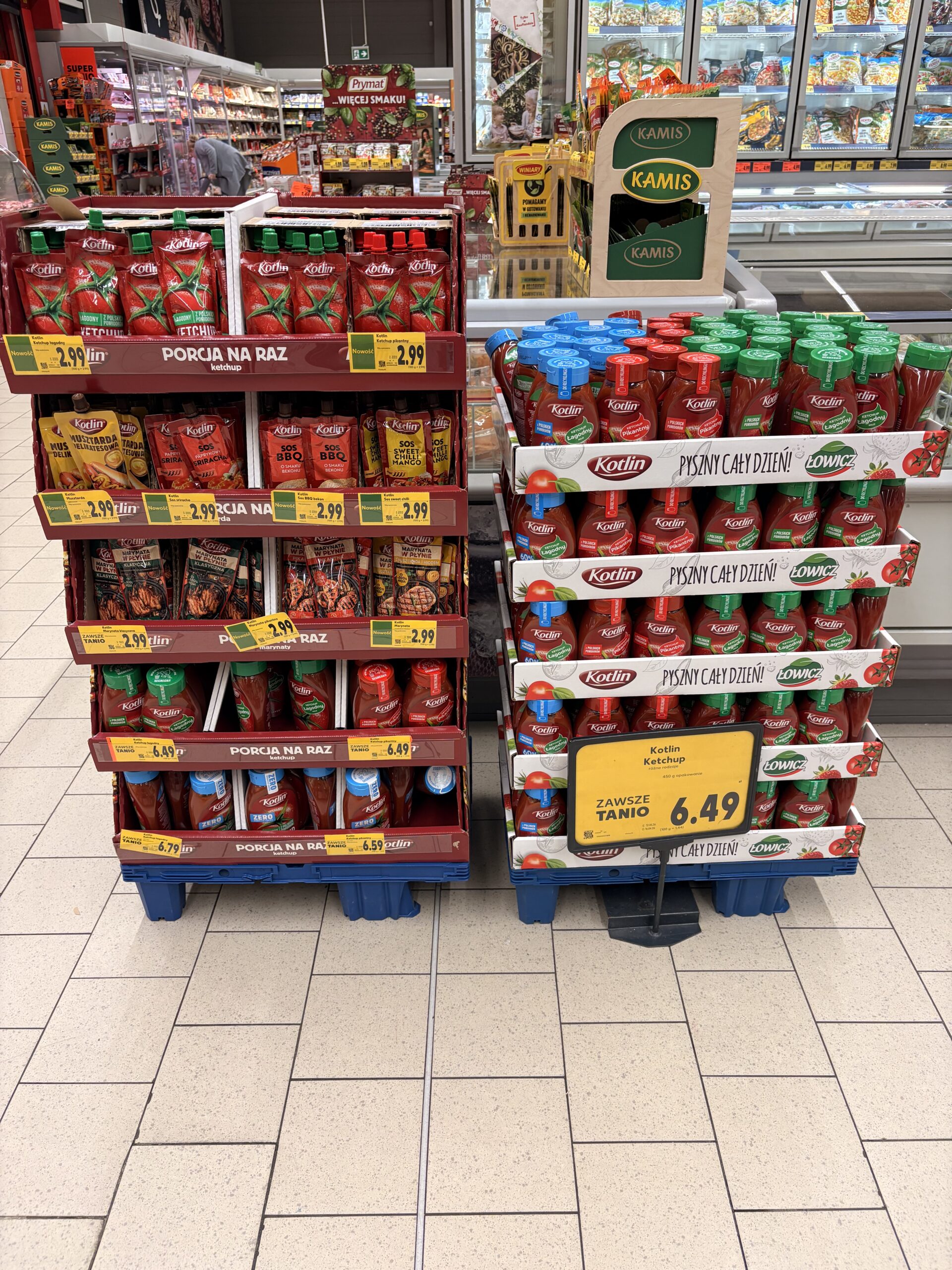
Displays #4 and #5. Two Maspex pallets: Kotlin “Porcja na Raz” sachets + Kotlin+Łowicz shared shipper.
Display #6: “SMMMAKUJE? TO GRILLUJMY” at the meat counter
We move deeper to the meat-deli-cheese counter. The shopper stands in line for 2-5 minutes, a forced dwell time unique in the entire store. To their left they see meat, to their right a full Kraft Heinz category campaign.
A branded Pudliszki shipper “SMMMAKUJE? TO GRILLUJMY” [Polish: “Tastes good? Let’s grill”] with a topper showing a family at a grill table. Hero visual: a sausage with ketchup on a grill. Header: “z polskich pomidorów BEZ KONSERWANTÓW” [Polish: “from Polish tomatoes, NO PRESERVATIVES”].
Left half of the pallet: Heinz Ketchup 1000 g at 15.99 PLN, in Heinz-branded trays with their own shelf tag. Smoking gun #2. Heinz fills the entire left half of a Pudliszki-branded shipper, in its own branded trays, with its own price tag. Display #3 could pass for a misplaced bottle; this cannot. It is deliberate. Kraft Heinz Poland coordinates this shared shipper of two brands of the same company.
Function in the Kraft Heinz funnel: conversion peak. Decisions are made here, during 2-5 minutes in the queue.
Display #7: Winiary and Pudliszki+Heinz side-by-side on the bread aisle (the orchestrator)
Display #6 and #7 stand side by side in one zone, each oriented to a different aisle. From the bread-aisle side you see them differently: Winiary on the left (Nestlé), Pudliszki+Heinz on the right (Kraft Heinz), side-by-side. The meat counter side fronts only Pudliszki+Heinz; the bread aisle in front sees both producers in one glance.
Two producers, two adjacent pallets, one cross-merchandising zone. Each producer has its own branding, its own price tags, its own shopper journey. Kaufland sold the zone itself twice, once to each pallet.
Winiary has its own exclusive shipper on the bread side: 3 SKUs (Ketchup 0 added sugar, Mild, Spicy) all at 6.99 PLN. Tagline “GĘSTY, POMIDOROWY, BEZWZGLĘDNIE PYSZNY” [Polish: “Thick, tomatoey, unconditionally delicious”] + sub-tagline “ZRÓBMY RAZEM COŚ DOBREGO!” [Polish: “Let’s do something good together!”], part of Nestlé’s CSR campaign “Klub Winiary”.
Next to Winiary, the Pudliszki+Heinz pallet is visible from this angle too, with the same Heinz “57” multipack and Pudliszki XXL bottles as on the meat side, just now seen from the bread aisle as well. The Kraft Heinz side isn’t trying to engage the bread-aisle shopper, but the pallets sit next to each other, not hidden. Stand in this spot and you’re looking at three brands of two corporations across two adjacent pallets.
The network (Kaufland) as category orchestrator. Kaufland designed a two-pallet cross-merchandising zone and sold each pallet to a different producer. Kraft Heinz took the meat-facing pallet (Pudliszki+Heinz); Nestlé took the bread-facing pallet (Winiary). The geometry is not symmetric. The Kraft Heinz pallet is also visible from the bread aisle, sitting right next to Winiary. The bread-aisle shopper sees both producers side-by-side; the meat-counter shopper sees only Kraft Heinz. The network maximizes listing fee from one zone; Kraft Heinz pays for one pallet but ends up visible from two aisles.
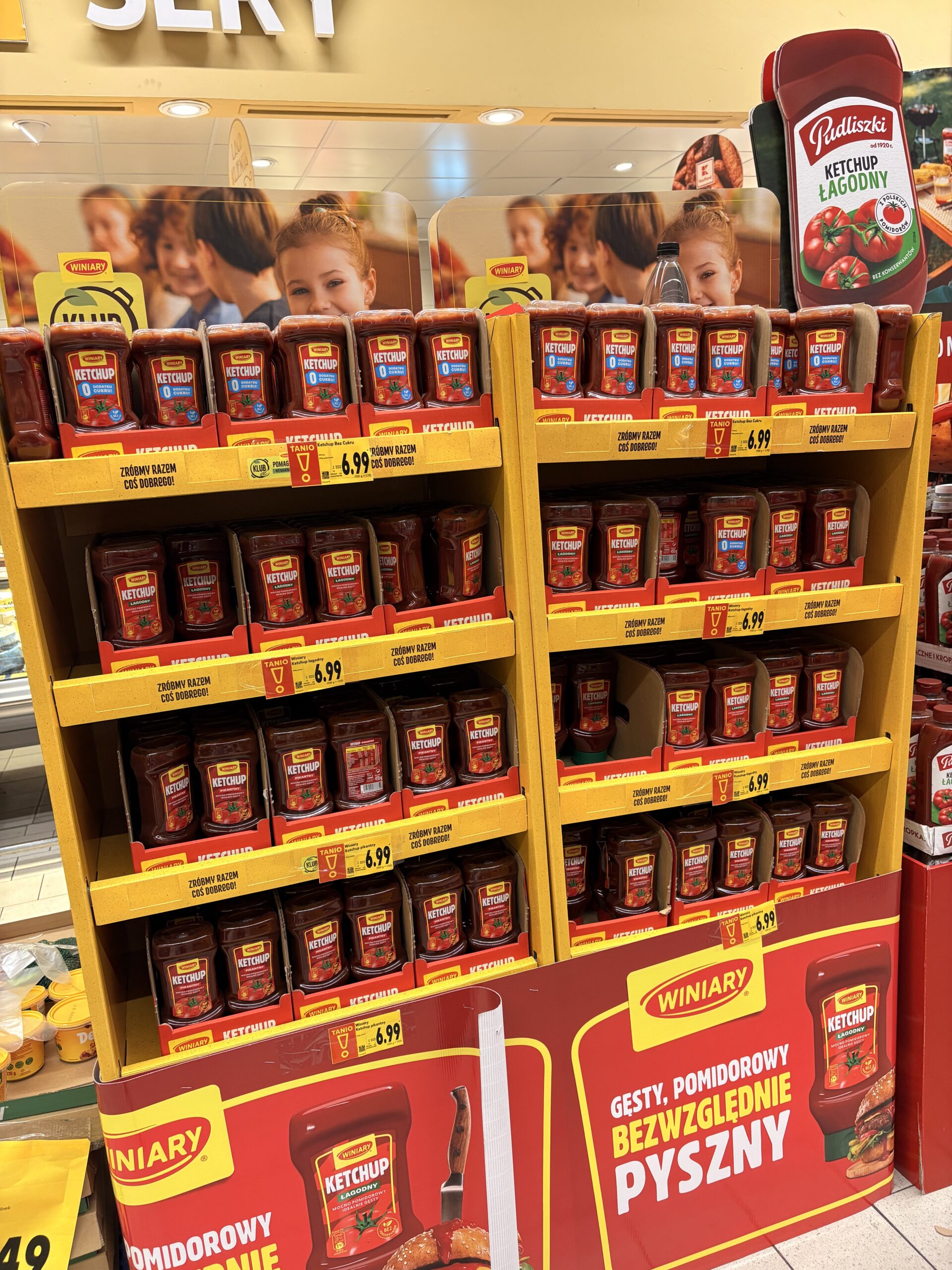
Display #7. Winiary (Nestlé) facing the bread aisle, on a pallet right next to the Kraft Heinz one. Two producers in one zone, not visible as competitors to the meat-counter shopper.
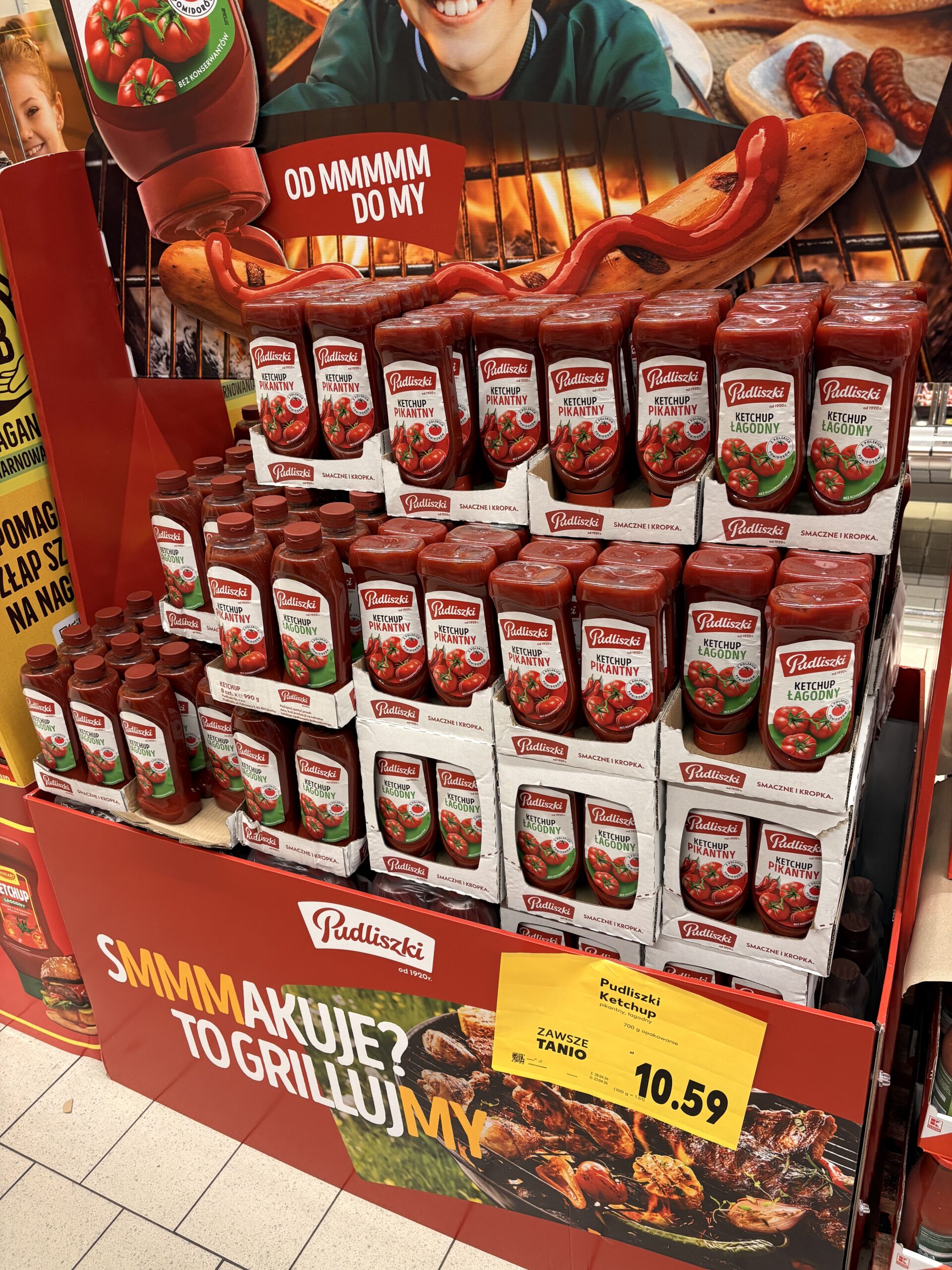
Another view of the same zone from the bread-aisle side. The Pudliszki+Heinz pallet sits right next to this Winiary one, both visible to the bread-aisle shopper in one glance.
Display #8: Utility Pudliszki at packaged cold cuts (last-touch)
The shopper leaves the meat section and enters the packaged cold cuts refrigerators (Sokołów, Tarczyński, Krakus). At the junction of these sections stands a pure pallet Pudliszki display: mass, raw and utilitarian. Only 2 SKUs (Mild and Spicy squeeze 700 g), price 10.59 PLN “ALWAYS CHEAP”, no creative, no portfolio play, no Heinz.
This is a distribution display. It serves shoppers who already decided. My reading is that Kraft Heinz builds the decision earlier, at Display #6 (the meat counter); here the display just fulfills the sale. Last touch with Pudliszki, the fifth time the shopper sees this brand in the store.
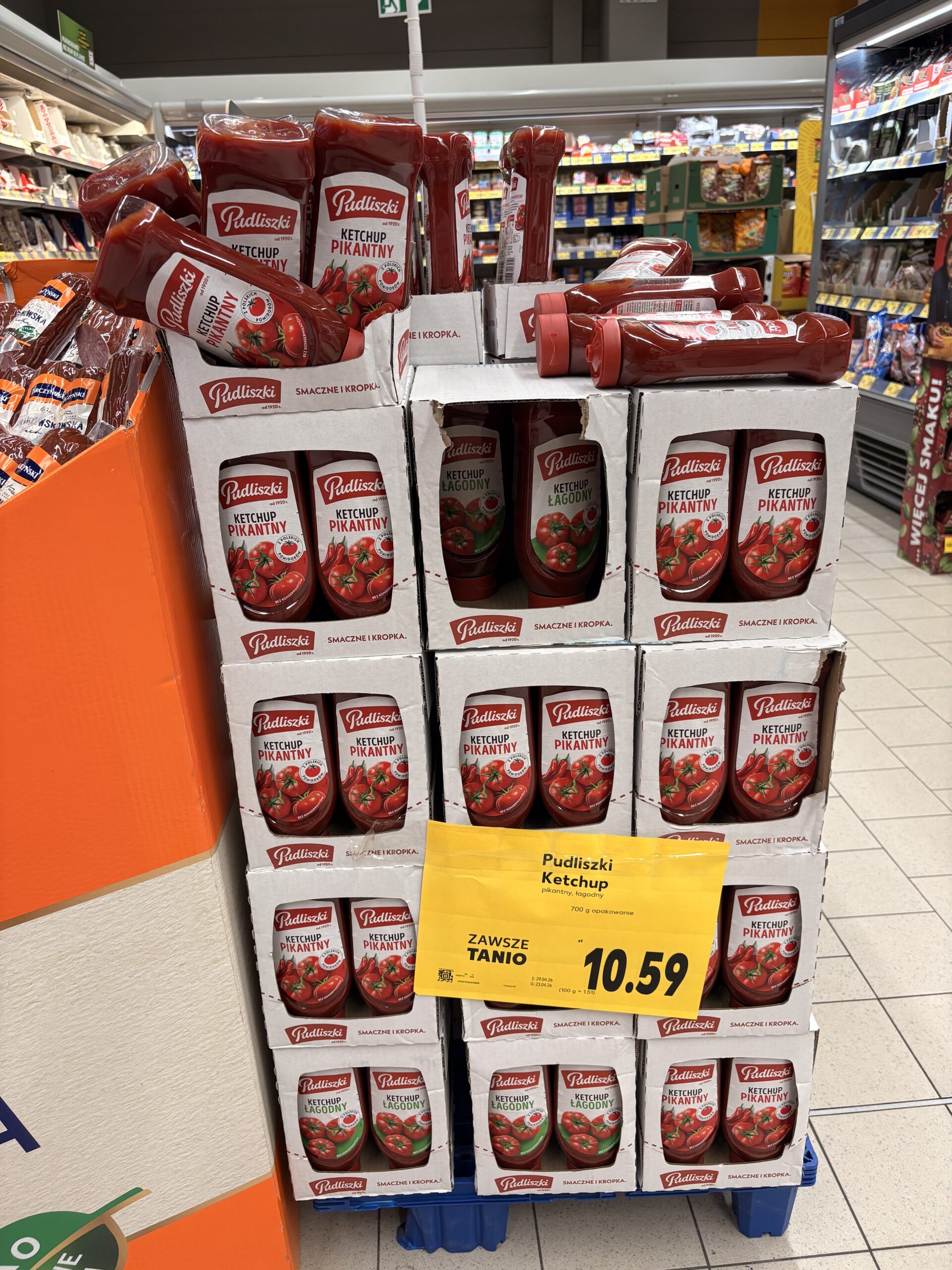
Display #8. Utility Pudliszki pallet, last-touch fulfillment for decided shoppers.
What the 8 displays reveal, once you map them as a system instead of separate placements.
Insight #1: 15 brands are a façade. 3 companies fight off-shelf.
The 15 brands you see are mostly a consumer-facing surface. Behind them sit 7 corporations and a handful of smaller independent producers, but only three actually fight for visibility outside the main shelf: Kraft Heinz, Maspex, and Nestlé.
The other brands had no off-shelf presence the day I was there: Develey, Hellmann’s (Unilever), Roleski, Tortex, Włocławek, Dawtona, Błonie, Benita, Kupiec, K-Classic. Łowicz sits in between: no pallet of its own, but its name is printed on the shared Maspex shipper. Some by choice, others by budget. Whether the same shelf-only pattern repeats in Auchan, classic Carrefour or other Polish chains is an empirical question, one for the next stores to answer.
K-Classic is the interesting outlier. Schwarz Gruppe owns the store itself, which makes them technically the most powerful party in this category, and yet they keep their own private label tucked up high with 2-4 facings. My read: their category data is telling them what works in ketchup, and it isn’t a cheaper unknown.
Insight #2: Portfolio play is not shameful, but the styles differ
Maspex prints it on the carton
The shipper carton itself is printed with both brand names, Kotlin and Łowicz, plus the slogan “PYSZNY CAŁY DZIEŃ!”. On the day I visited, the pallet held only Kotlin bottles, but the carton design signals the portfolio either way. Whether Maspex uses this reusable design across Kotlin-only, Łowicz-only, or mixed campaigns doesn’t change what it says: same company, two brands.
Maspex seems to say: “we’re one company, see?”
Kraft Heinz plays it subtler
Heinz on a Pudliszki-branded shipper, with its own Heinz price tag on the pallet, but no shared topper. A consumer seeing Pudliszki and Heinz next to each other usually thinks “Polish Pudliszki + global Heinz + coincidence”.
Kraft Heinz seems to say: “here are two different brands for two different shoppers”.
With two pieces of matching evidence in one store (Display #3 and Display #6), the Kraft Heinz pattern is a deliberate, coordinated system. Both approaches work, on different bets.
Insight #3: Every display has a role. Kraft Heinz Poland built a 5-stage funnel.
Kraft Heinz gives each of its five locations a different job.
Display #1: Entrance (Heinz)
Brand awareness reminder. Weakest link, but presence.
Display #2: Gondola end (Pudliszki + Hellmann’s anchor)
Decision gate / category gate-keeper. Closes the decision before the aisle.
Display #3: Aisle display (Pudliszki + Heinz + chips)
Trade-up XXL + cross-merchandising with snacks.
Display #6: Meat counter (Pudliszki + Heinz full campaign)
Conversion peak. Full 360° campaign + full portfolio. 2-5 min forced dwell time.
Display #8: Cold cuts cooler (Pudliszki utility)
Last-touch sales fulfillment for decided shoppers.
This is what mature category management looks like: invisible to the consumer and easy to miss without context. None of the other producers in this category came close.
Insight #4: Kaufland plays this category itself
Kaufland plays this category itself, on top of renting out the space.
- →Sells two pallets in one cross-merchandising zone to different producers (Kraft Heinz facing the meat counter at #6, Nestlé facing the bread aisle at #7: one physical zone, two listing fees).
- →Drops competitor brands at gondola ends as price anchors (Hellmann’s 9.99 PLN on Display #2, matching the promoted Pudliszki price for half the volume, which breaks Kraft Heinz’s grip on the end-cap).
- →Pulls listing fee out of every physical spot worth paying for.
- →Decides which producers get off-shelf and which stay on the main shelf.
The consumer doesn’t see it. The producer pays. The network collects. That’s the full map of category power.
— Closing observationWrap-up: what’s next in FMCG Anatomy
One Kaufland reveals the structure of an FMCG category that most shoppers don’t see. 8 ketchup displays, 3 corporations behind all of them, 10 brands serving only the main shelf. Plus a five-stage purchase funnel designed by one company, Kraft Heinz Poland, in one store.
This is the standard of modern category management in mature FMCG markets. The same patterns repeat in beer, sweets, coffee and pasta: corporate portfolio dominance, the fight of 3-4 companies for cross-merchandising, and the network as orchestrator.
In upcoming episodes of FMCG Anatomy, we’ll show these categories from the same perspective, including markets beyond Poland (Italy, Germany, UK).

Marcin Grzegorczyk
Director of Market Development & Sales Enablement, Asseco Business Solutions
I lead market development and sales enablement for Asseco Platform, a European FMCG retail execution platform with 125,000+ users across 74 countries. My day-to-day mixes brand positioning, category narrative, lead generation, and field research like the one you just read.
FMCG Anatomy is the long-form analysis cycle where I publish what I see in real Polish retail, category by category, store by store. The goal is to make the invisible structure of FMCG categories visible: brand façade vs corporate layer, customer journey, off-shelf battle, the network as orchestrator.
Frequently asked questions
How many brands of ketchup are sold in a typical Polish hypermarket?
In hypermarket compact stores like Kaufland, the ketchup category typically spans 12-18 brands. The store analyzed here had 15 brands on the main shelf, which is well within this range. Behind those brands, however, stand only 7 corporations plus a small group of smaller independent producers.
Is Pudliszki a Polish brand?
Pudliszki is a Polish heritage brand corporately owned by Kraft Heinz (USA) since the H.J. Heinz Company acquired it in 1997. The brand identity is built around Polish heritage, but the corporate owner is American. It’s a clear example of the gap between brand identity and corporate ownership in FMCG.
What is an off-shelf display in retail execution?
An off-shelf display is any product placement outside the standard category shelf: pallets, branded shippers, gondola ends, end-caps, two-sided modules, cross-merchandising with adjacent categories. Off-shelf displays typically require a listing fee paid to the retailer and are where most of the real FMCG category competition happens.
What is “FMCG Anatomy”?
FMCG Anatomy is the long-form analysis cycle where I publish what I see in real Polish retail, category by category, store by store. Each episode walks through one category in one retail format, mapping the brand layer vs the corporate layer, the customer journey, the off-shelf battle, and what it means for producers and retailers. This is episode #01.
Want to see your category the way Kraft Heinz sees this one?
Asseco Platform has been delivering retail execution solutions for FMCG producers in 74 countries for over 30 years. If your organization wants to understand how your category looks from the shelf and the shopper’s perspective, let’s talk.
Talk to our team →