





Planogram compliance without the clipboard
Field reps spend 15-30% of every store visit filling shelf audit forms. Image recognition replaces the clipboard — reps go back to selling, and planogram data arrives faster and more reliably than a human audit could ever produce.
A field sales rep walks into a store carrying a tablet. Before the conversation with the store manager starts, before a single SKU gets reordered, the rep has to fill in a shelf audit form: 20 to 60 questions about facings, share of shelf, planogram adherence, out-of-stock. Across 8-12 visits a day, that audit work eats 15 to 30 percent of every visit. The rep is in the store, but not selling.
The data the audit produces is subjective — what one rep counts as “on-planogram” another might not. Planogram compliance is the problem most FMCG manufacturers know they have, and the solution most of them are still asking reps to deliver by hand.
What planogram compliance actually measures
Planogram compliance is the gap between the shelf layout a category manager designed — number of facings per SKU, sequence, eye-level placement, secondary placement — and what a shopper sees in the store right now. Closing that gap is one of the few in-store levers a manufacturer can actually control through field execution.
When compliance is enforced, sell-out follows. When it is not, the brand pays twice: once for the trade investment that put the product on the shelf, and again for the lost sales when the planogram drifts.
The honest part of the problem: knowing whether the planogram is being followed is itself expensive. Traditional approaches put the cost on the rep, who fills in a survey at every visit and produces data that is slow, inconsistent across reps, and unverifiable after the fact.
How image recognition replaces the audit form
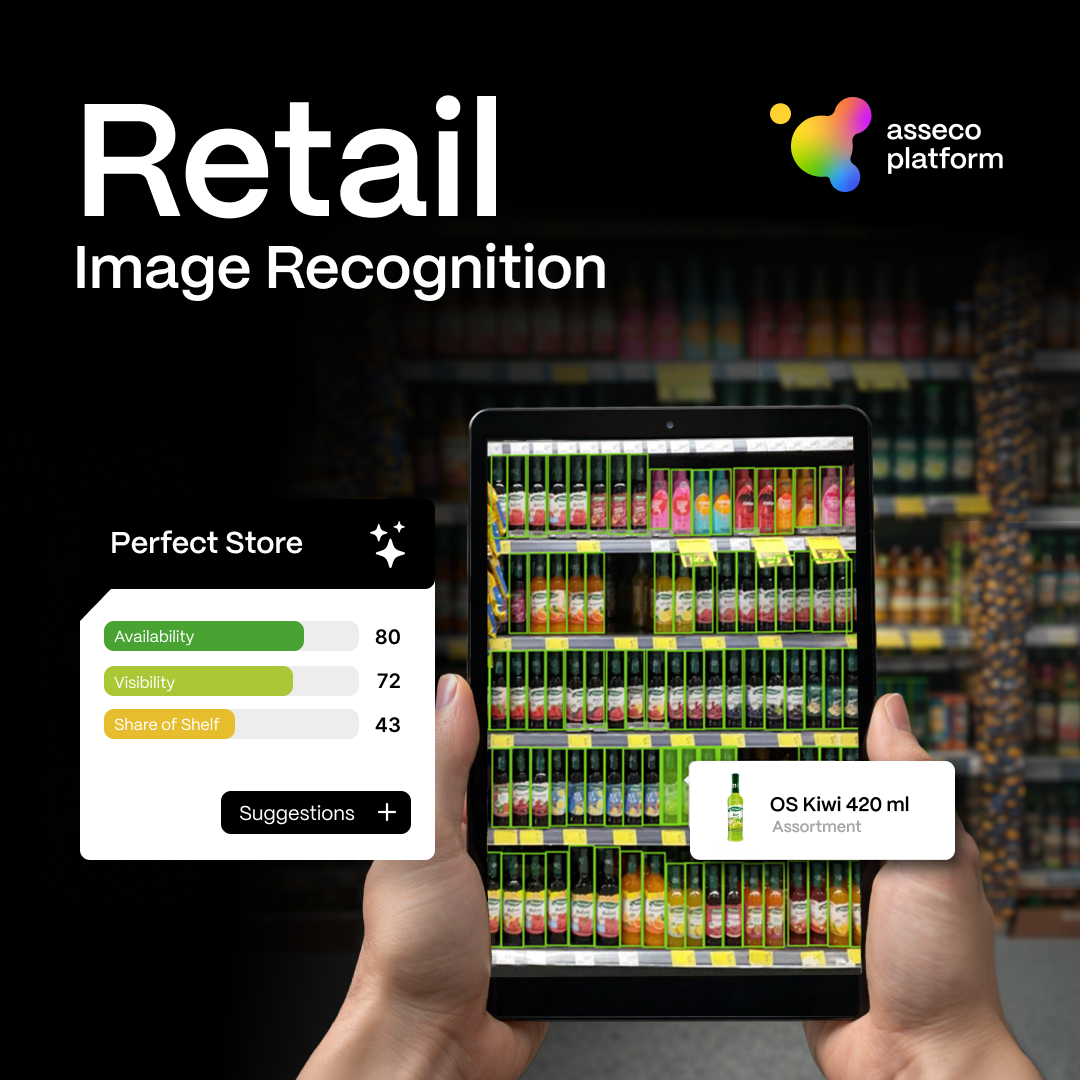
Retail Image Recognition uses computer vision to extract structured shelf data from a photograph. The rep takes a picture of the shelf with their tablet. The system identifies every SKU on the shelf, counts facings, checks sequence and position against the planogram, detects out-of-stock, and returns a compliance score in seconds.
The audit form does not disappear because the rep stops caring about compliance — it disappears because the data the form was trying to capture is now extracted from the photo automatically. Modern image recognition systems run at up to 98% recognition accuracy on trained SKU catalogs, which puts the data quality above what a human audit could produce even with full attention.
The shift is operationally simple and strategically significant:
Rep visits store → spends 15-30% of visit on audit form → data is subjective, late, and partial.
Rep visits store → takes a photo of the shelf → audit data arrives objective, complete, and time-stamped — while the rep moves on to selling.
The time-on-task outcome
The clearest outcome of removing the audit from the rep’s hands is reclaimed selling time. Reps stop being part-time enumerators and go back to being full-time sales people.
In a February 2026 interview with Portal Spożywczy, Paweł Głowniak, Commercial Director at Herbapol-Lublin — a Polish FMCG leader in tea, beverages, syrups, and jams — described the shift in plain terms:
“Thanks to advanced systems like Image Recognition, we get reliable information about the situation in stores, and our sales representatives save time by not having to fill in questionnaires. Their store visits are more effective in business terms.”
Paweł Głowniak · Commercial Director, Herbapol-LublinThe framing is worth noting. Głowniak does not lead with the technology. He leads with the outcome: reliable shelf data, and reps with more selling time. The image recognition piece sits underneath, as the mechanism that makes both things possible at the same time.
Original Polish: „Dzięki zaawansowanym systemom jak Image Recognition, dostajemy pewną informację o sytuacji w sklepach, a nasi Przedstawiciele Handlowi oszczędzają czas nie musząc wypełniać ankiet. Dzięki temu wizyty handlowe są bardziej efektywne biznesowo.” Source: Portal Spożywczy, 13 February 2026. Translated to English by Asseco Platform editorial.
Objective data instead of opinions
The second outcome is harder to see in a quarterly P&L but louder in monthly reviews: the data stops being negotiated.
When shelf data comes from a rep filling in a form, every number is filtered through that rep’s interpretation. A planogram with 6 SKUs in a 5-facing strip might be marked “compliant” by one rep and “non-compliant” by another. The conversation in the next sales meeting then becomes about the data itself, not about what to do.
When shelf data comes from image recognition, the photo is the source of truth. Disputes shift from “is this compliant” to “what should we do about the gap” — which is the conversation a field organization actually wants to have.
Głowniak’s phrase — “reliable information about the situation in stores” — is the operational definition of what this changes. Reliable, in this context, means the same shelf produces the same answer regardless of which rep visited.
Compliance enforcement without policing
The third outcome shows up in the KPI engine — the part of the system that turns shelf data into action.
Image recognition is not useful in isolation. The photo produces a compliance score, but the score has to land in someone’s workflow. Modern retail execution stacks pipe the score into the rep’s next task list, the territory manager’s exception report, and the category manager’s planogram review. A 60% compliance score in store #4127 is not a metric to be admired; it is a task that appears in the rep’s schedule for the next visit.
That closes a loop that traditional audit-form-based compliance never closes well. The data is captured fast enough, and presented in a usable enough shape, that the next visit corrects what the last visit found. Field managers stop policing compliance retroactively and start running it as an operating cadence.
What it takes to deploy
The honest constraints, because outcome-led narrative without operational constraints is just marketing:
- Trained SKU catalog. Image recognition needs to know the products. Onboarding a new manufacturer’s portfolio means building a recognition model against current packaging — typically a one-time setup, then incremental updates per new SKU or pack redesign.
- Recognition accuracy threshold. Production-grade systems reach up to 98% accuracy on trained catalogs. Below that, the audit form does not actually go away — it gets replaced by a dispute queue, which is worse.
- Integration with the SFA workflow. The photo capture has to live inside the existing visit flow. A separate “shelf audit app” reintroduces the friction the system was meant to remove.
- A KPI engine downstream. The compliance score has to feed something — a territory dashboard, a task generator, a perfect-store score. Without that, image recognition produces accurate data into a vacuum.
These are not blockers. They are the actual work of moving a field organization from clipboard-based audits to image-based compliance. Most FMCG manufacturers underestimate the catalog build and overestimate the technology risk.
Where this sits in the field execution stack
Retail Image Recognition is part of Asseco Platform’s Sales & Retail Execution stack. It is deployed alongside the SFA application that field reps use day to day, so the shelf photo and the rest of the visit data — orders, queries, in-store negotiation notes — sit in one record per visit.
For organizations running KPI-based store cycles, Image Recognition feeds the Perfect Store module, which converts compliance, OSA, and share-of-shelf data into the store-by-store score that drives the rep’s next visit plan.
Frequently asked questions
What is planogram compliance?
Planogram compliance is a measure of how closely the actual layout of products on a store shelf matches the planogram a category manager has designed — number of facings per SKU, sequence, eye-level placement, and adjacency rules. High compliance correlates with sell-out; low compliance signals that trade investment is being lost on the shelf.
How accurate is image recognition for shelf audits?
Production retail image recognition systems deployed against trained SKU catalogs operate at up to 98% recognition accuracy. Accuracy depends on three factors: the quality of the trained catalog for the brand’s portfolio, the photo capture conditions in-store (lighting, angle, distance), and the frequency with which the catalog is refreshed when packaging changes.
Does image recognition replace field reps?
No. It removes the audit form, not the rep. The objective of the system is to give reps back the 15-30% of visit time that audit work consumes, so reps can spend that time on the parts of the visit a tablet cannot do — conversation with the store manager, in-store negotiation, secondary placement, problem resolution.
How long does deployment take?
The technology integration is the fast part — usually weeks, depending on the SFA platform already in place. The slower part is the SKU catalog build, which can take 4 to 12 weeks depending on portfolio size, packaging variant complexity, and whether competitor SKUs need to be recognized for share-of-shelf measurement.
Want to give your reps their selling time back?
See how Retail Image Recognition replaces shelf audit forms in your field organization — without taking reps off the selling floor.
Talk to us →